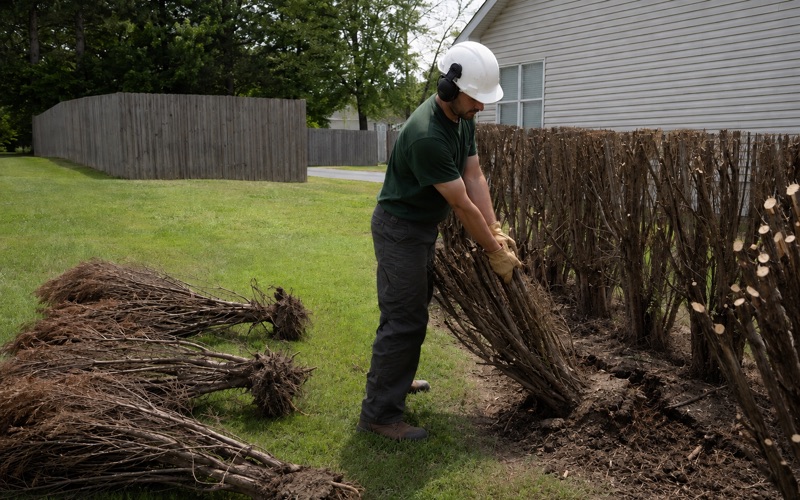
Franklin Tree Removal has been doing tree removal in Ashland City for more than twenty years, working both the Highland Rim side of the Nashville metro and the basin ground east of it. What decides a removal here is rarely paperwork. It is the pitch of the ground, the distance from the trunk to the nearest place a chipper can stand, and what sits under the tree if a section goes wrong.
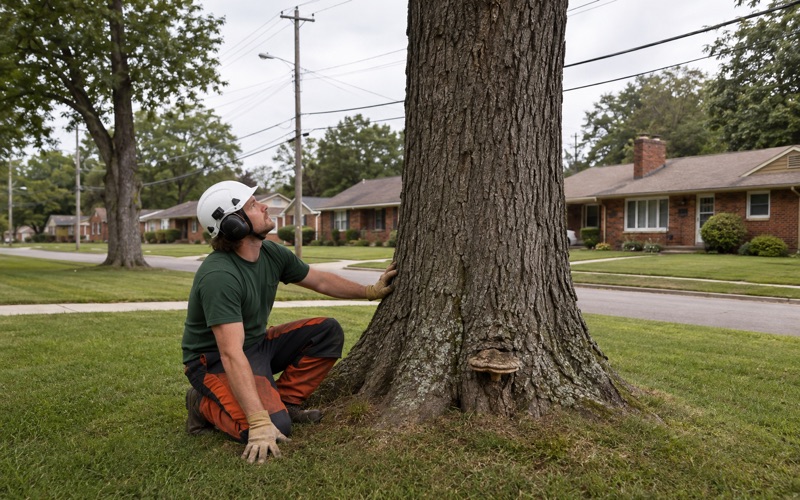
Every job starts with a walk of the property and a tree risk assessment, not an estimate written from a photograph. We measure diameter at breast height, look at the root flare, and check the union of any co-dominant stems for included bark before we quote a price. If the tree can be cabled, braced or pruned to the ANSI A300 standard instead of removed, that is the recommendation you get.
We also read the code that applies before the saw comes out, because the answer changes from one town to the next across this metro. In Ashland City that answer is a short one, and it is worth knowing exactly where it starts and where it stops.
What the town code says about the trees on your property
Ashland City has no ordinance governing the removal of a tree from private property, and that is a matter of record rather than a gap in our research. Ordinance #085, dated August 10, 1992 and titled the Tree City USA Ordinance, would have governed the planting, maintenance and removal of trees, shrubs and plants within the town limits. The town’s own ordinance library records it as withdrawn, and it did not pass.
What does reach a residential yard is the nuisance section. Ashland City Municipal Code Title 8, Chapter 1, Section 8-112, added by Ordinance #78 on second reading in July 1991, names the growth of trees among the conditions the town may declare a nuisance where they endanger health, safety or welfare. An owner has ten days to remedy the condition after notice by registered or certified mail, and where the town abates it instead, the cost becomes a lien on the property collected the way property taxes are collected.
An appeal goes to the board of mayor and aldermen within ten days of that notice, with judicial review after it. This is the clause behind a dead tree leaning toward a sidewalk or a neighbor’s roof, and it is better understood before a certified letter arrives than after.
The 50 percent credit for a tree you keep
The town’s other tree provision is a development standard rather than a homeowner rule. Article III, Section 3.140 of the Zoning Ordinance, as amended by Ordinance #561, sets the landscaping, screening and buffering requirements for development that needs a site plan or a master development plan, and it expressly does not reach single-family detached housing that is not part of a planned unit development. If you are taking a tree off a house lot, this section is not aimed at you.
It is still worth reading, because it is the one place the town puts a number on a standing tree. The requirement is a minimum of 35 caliper inches of proposed trees per acre, with 75 percent of the required trees native to the southeastern United States, no canopy tree accepted below 2 caliper inches and no understory or ornamental tree below 1.5 caliper inches. Existing trees protected and retained count 50 percent of their size toward that per-acre requirement, though not toward the parking area requirement, and a floor of 18 caliper inches per acre of proposed trees applies where the credit would otherwise zero the new planting out.
The credit carries a condition. A landscape plan has to locate every existing tree of 8 caliper inches and greater, delineate forested areas, indicate the species mixture, and be prepared and sealed by a landscape architect licensed in the State of Tennessee. On a commercial or subdivision site, that makes a healthy canopy tree worth half its caliper against a planting bill, which is a concrete reason to ask whether crown cleaning or a crown reduction would serve as well as a removal.
Looking for tree removal closer to Mount Juliet? See Tree Removal Services in Mount Juliet.
Steep Highland Rim slopes and what they do to the work
Ashland City sits on the northeast bank of the Cumberland River near the Harpeth confluence, at an elevation of about 430 feet, with steep ground rising directly behind the town. Cheatham County’s most extensive soil unit, in the NRCS Web Soil Survey data, is the Hawthorne-Sulphura association at roughly 67,000 acres on 20 to 60 percent slopes, somewhat excessively drained. A dominant map unit at that pitch is a statement about access before it is a statement about soil.
Access decides the method
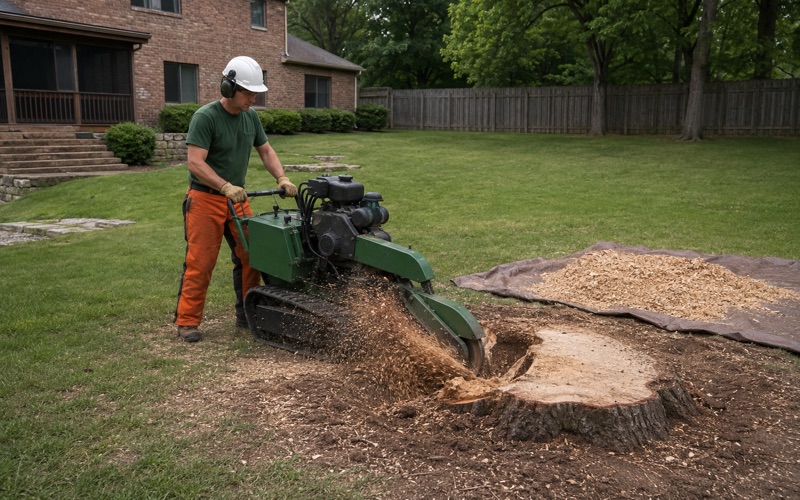
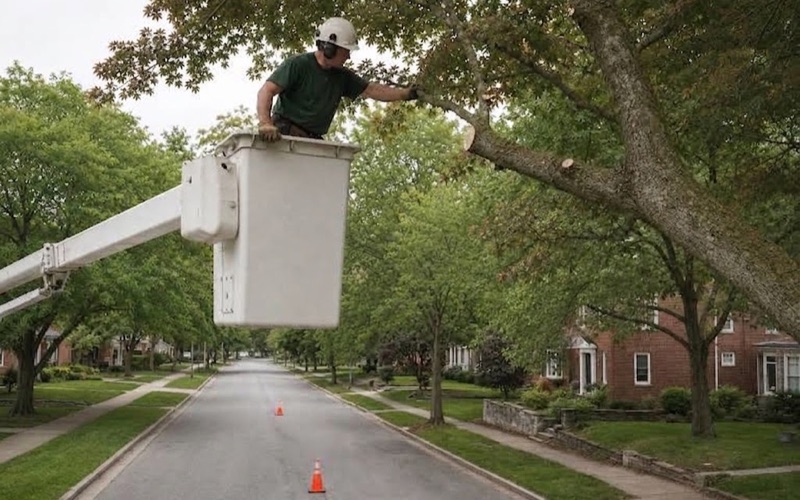
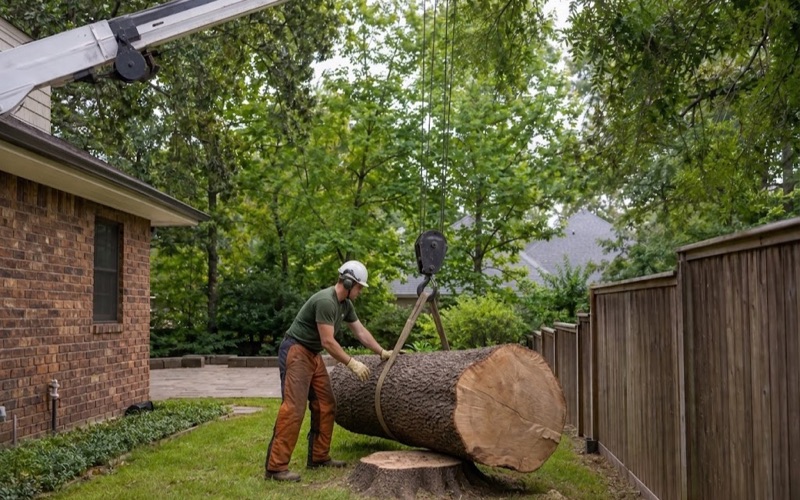
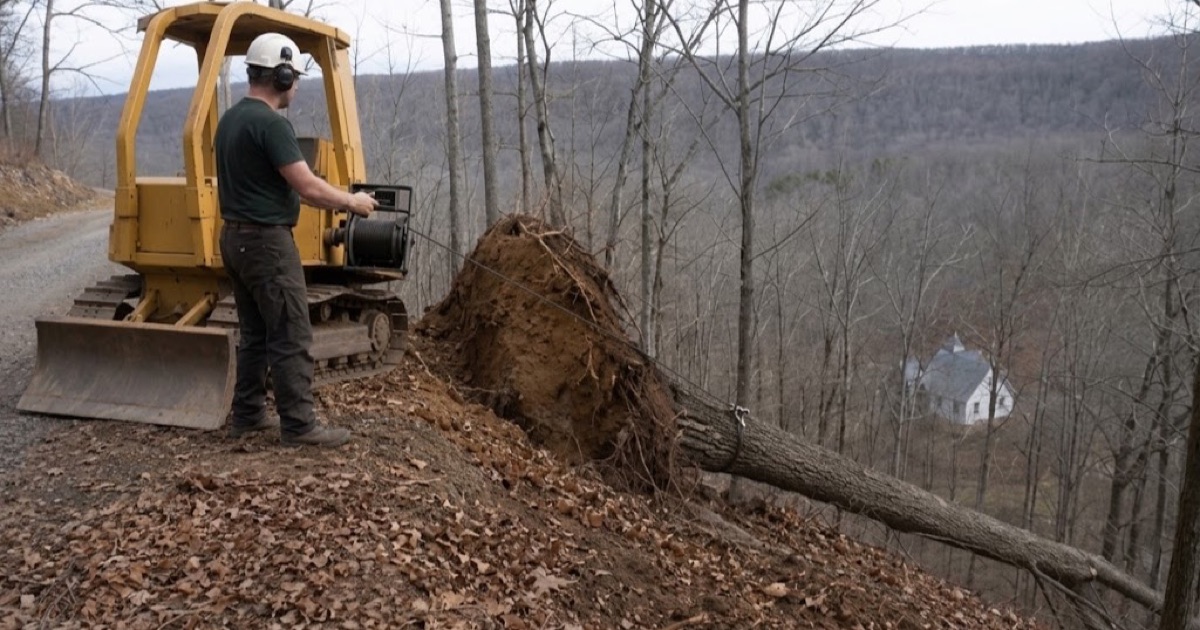
On a slope of 20 to 60 percent with cherty, fast-draining ground under the tracks, a crane cannot be set and a bucket truck often cannot reach the trunk at all. The ordinary removal on a hillside lot here is a climb-and-rig job worked with a rigging and lowering device, a long carry to the chipper, and a decision made in advance about where every piece lands. We bring compact tracked equipment that fits a thirty-five-inch gate, which keeps a back-yard tree from becoming a crane job by default, and crane and rigging capacity for the mature canopy that does warrant it.
Chert, fragipan, and why trees fall here
The Hawthorne series formed in residuum of interbedded siltstone and cherty limestone. Its official series description puts depth to soft bedrock at 20 to 40 inches, hard bedrock below 40 inches, and slopes ranging from 5 to 70 percent. A tracked stump grinder working 12 to 16 inches below grade therefore stays inside soil on a Hawthorne unit, so the chert is a wear problem on teeth rather than a refusal.
The root restriction on Highland Rim ridges is not shallow bedrock, and this is the part most easily gotten wrong. The Dickson series, common on those ridges, carries a fragipan at a depth of 18 to 36 inches: bedrock is more than five feet down, but the pan is slowly to very slowly permeable and roots do not readily cross it. A tree on that ground builds a shallow, plate-like root system with water perched on the dense layer after heavy rain, and windthrow follows with no bedrock involved at all.
Highland Rim soils are also described as cherty, acid and low in fertility, so a damaged root system recovers slowly. Where a tree is meant to stay, that argues for root collar excavation with an air spade inside the tree protection zone rather than a trencher through it.
Ridge trees, bottomland trees, and the storms this county gets
The Western Highland Rim canopy is oak-hickory, with scarlet oak, chestnut oak, black oak and post oak on the drier sites and beech-maple or beech-tulip poplar-white oak communities on the moister slopes. The bottomland along the Cumberland and the Harpeth adds the wetter-site species, so one property here can carry a dry ridge assemblage at its upper end and a floodplain one at the bottom.
On terrace and bottomland ground the failure we are called to most often is at the root plate, on trees grown fast in deep soil with little wind exposure until something beside them comes out. Up the slope it tends to be structural: co-dominant stems with included bark, a conk at the base, deadwood hanging over a driveway. Deadwooding and crown thinning answer some of that, and a written condition report naming what we found is something you can hand to a neighbor, an insurer or a reviewer.
Ice, wind, and the warning that covers this county
Ashland City sits in National Weather Service public forecast zone TNZ026, a single-county zone named Cheatham served by the Nashville forecast office, so a warning issued for it covers this county and not the ones around it. Middle Tennessee averages 18 tornadoes a year across 1995 to 2025, against 8 for the West Grand Division and 6 for the East, and the damage pattern here is convective and cold-season rather than tropical.
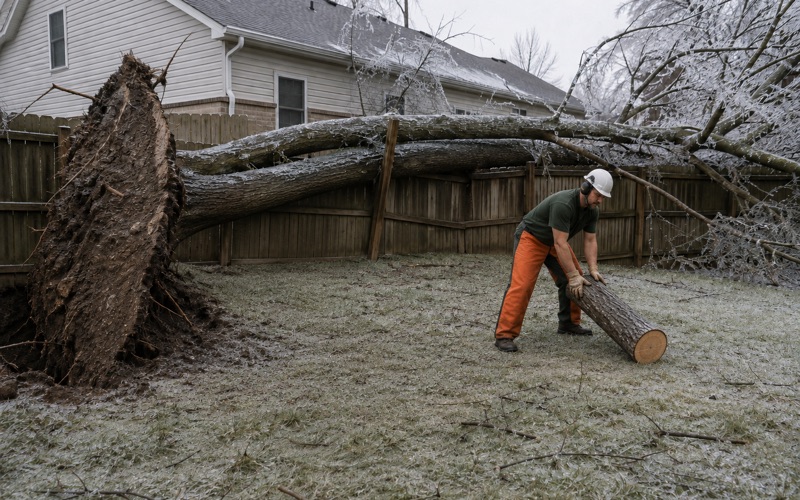
The two storm types leave different work behind. The ice storm of January 25 and 26, 2026 laid down 0.50 inch or more of accretion, with a statewide peak of about 230,000 customers out and 444 broken poles, and ice loads fail limbs by weight, which puts the failure in the crown and over the roof. The derecho of June 21, 2019 crossed every Middle Tennessee county with more than 100,000 outages and took whole trees over.
We plan storm response around that pattern rather than a generic hurricane script. A limb hung after an ice event and a leaning root plate after straight-line wind are different rigging problems, and we will say which can wait for a scheduled day and which cannot.
Utility lines, disposal, and who is licensed to do the work
The electric right of way through town belongs to Cumberland Electric Membership Corporation, a rural cooperative rather than a municipal utility. CEMC maintains a 20-foot clearance on both sides of its lines, states that it has the right and the obligation to manage vegetation within that right of way, and asks members not to prune there themselves.
Where the work touches a secondary service line, the drop that runs from the pole to your house, CEMC requires a service order before anyone prunes or removes near it, requested through 800-987-2362. That is a scheduling dependency rather than a formality, so we identify it at the estimate and make the call then instead of finding it on the morning of the job.
Disposal follows a town rule, not the county one
Within the Ashland City limits a burn permit is required year-round through the city, and only natural vegetation may be burned; household trash is expressly excluded. Beyond the limits, the Tennessee Division of Forestry permit season runs October 15 through May 15 for fires within 500 feet of forest, grassland or woodland, and its online route through BurnSafeTN.org covers individual leaf or brush piles of roughly 8 feet by 8 feet or smaller.
A single mature tree exceeds that pile size many times over, which is why chipping and haul-off, not burning, is the realistic disposal path on a removal here. Nothing in state law restricts what happens to the wood afterward: Tennessee repealed its emerald ash borer, pine beetle and thousand cankers disease quarantines in 2021, and the requirements that remain apply to material entering the state.
Credentials, and what the written scope covers
Tennessee issues no arborist or tree-care license of any kind, and the state contractor license threshold begins at $25,000 of total materials and labor. The separate Home Improvement license, which covers work from $3,000 to $24,999 and carries a $10,000 surety bond, applies only in the counties that adopted it, and Cheatham County is not on that list. A residential job in that price band here carries no license requirement, which leaves insurance, ISA Certified Arborist credentials and adherence to the ANSI Z133 safety requirements as the things worth asking about.
We put the scope in writing before we start: the stump, the trunk rounds, the grindings and the chips, and who takes each of them away. Estimates are free, and if the job is not worth an insurance claim we will say so rather than let you find out from an adjuster.
- 20+ Years in Middle Tennessee
- Free Estimates
- Written Scope Before We Start