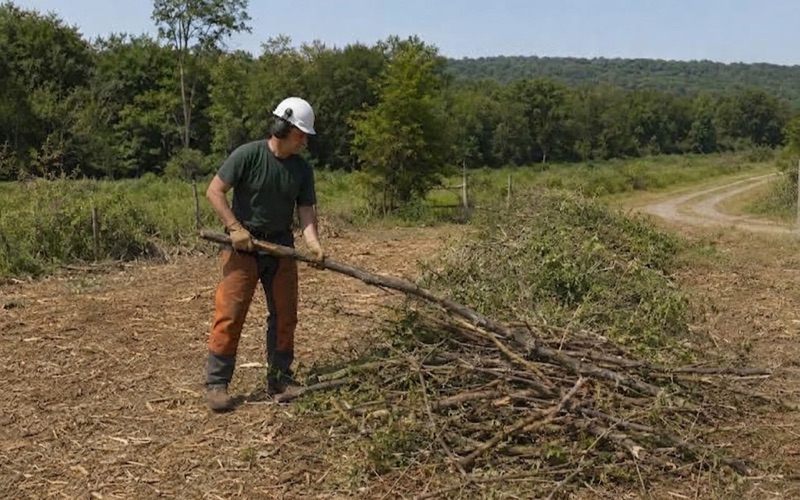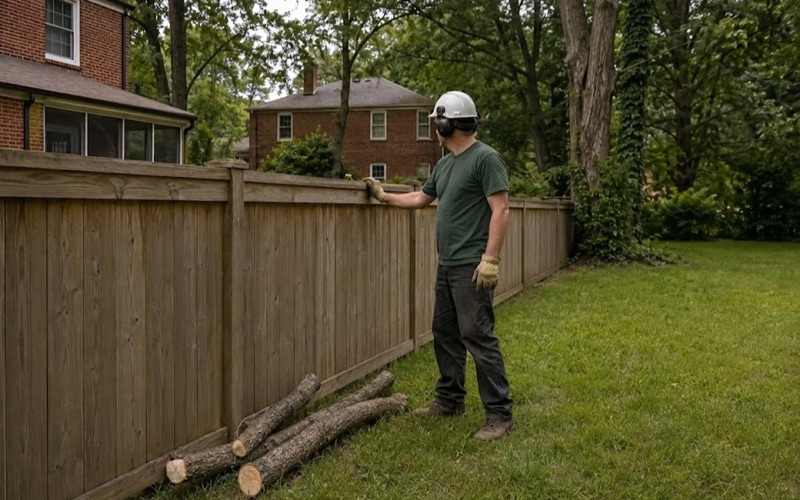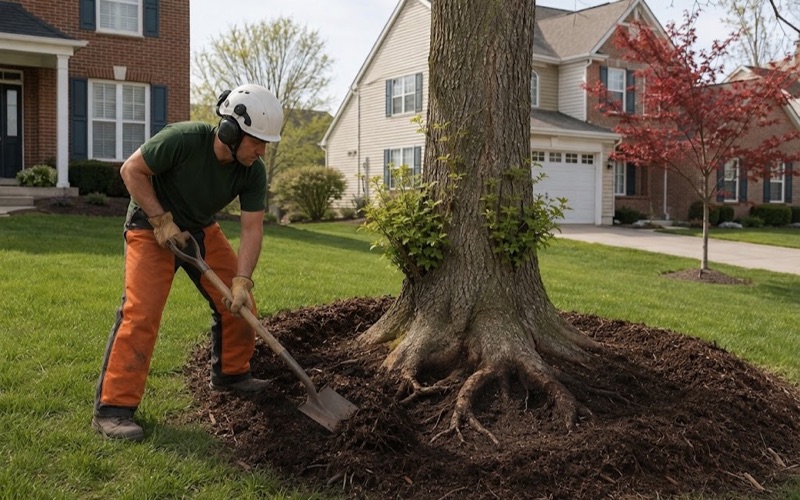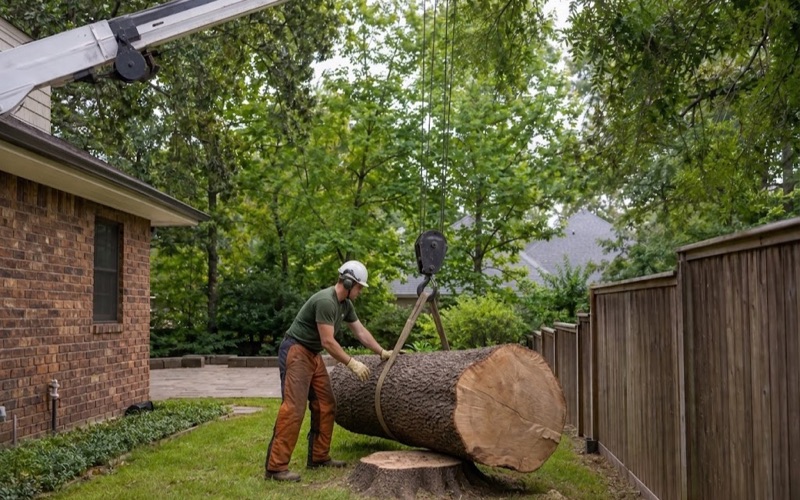
Franklin Tree Removal has been doing tree removal in Brentwood for more than twenty years, and the first question we settle on a Brentwood property is not how large the lot is. It is what the tree is. The city’s tree preservation ordinance, 78-511 of the zoning chapter, does not gate private removal by acreage at all. It gates it by category, and a tree that lands in one of four defined categories needs planning commission permission before a saw comes out.
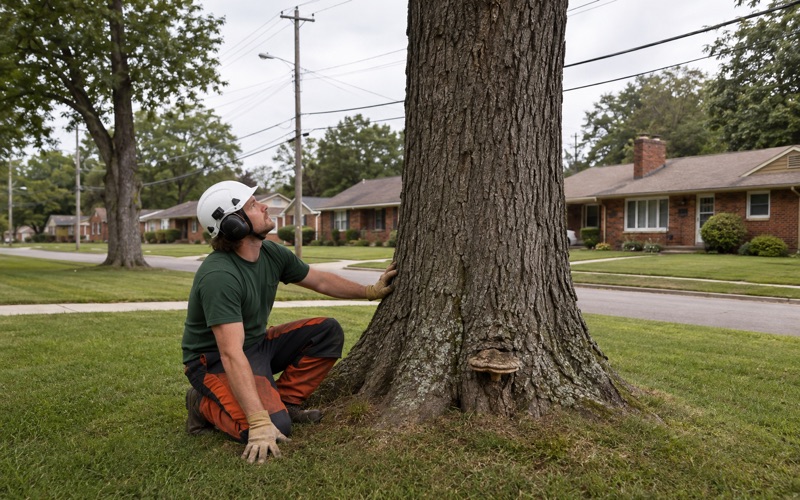
That single difference sets the order of our work. We identify the species, measure at the root flare and at diameter at breast height, and establish whether the tree sits inside a designated protection area before we price a removal. Running that sequence backwards is costly here, and the ordinance’s penalty structure is the reason why.
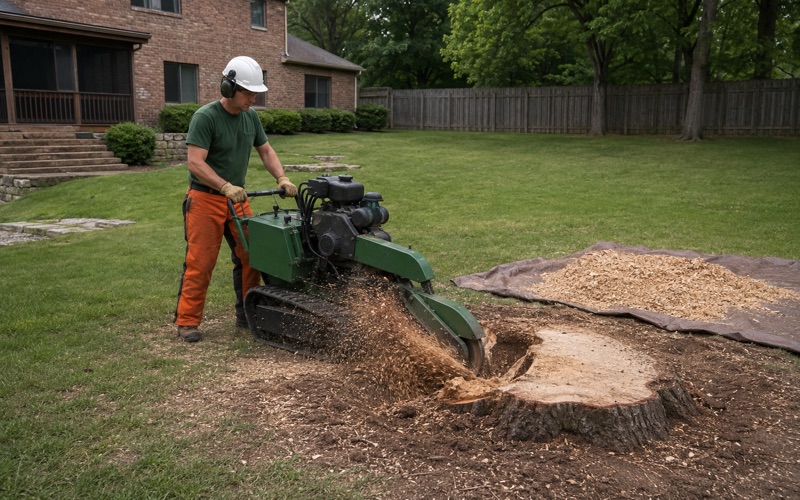
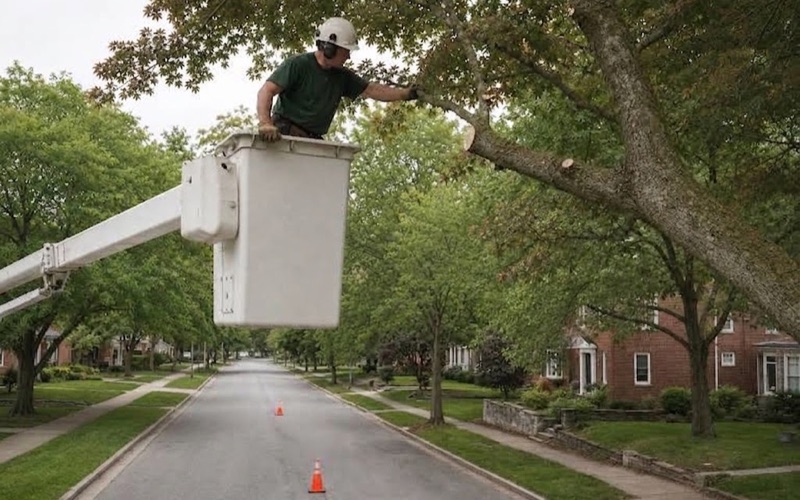
After that comes equipment matched to the property: compact tracked machines narrow enough for a thirty-five-inch gate, crane and rigging capacity for mature canopy, and a written tree condition report a homeowner can hand to a neighbor, an insurer or a city reviewer.
Permission here turns on the category, not the acreage
The tree management article sits inside Chapter 78, the zoning chapter, and it is specific about what it covers. Removal without planning commission permission is prohibited for four things: a tree designated rare or endangered by a state or federal agency, a tree of historical significance identified by the historic commission, a protected tree of six or more caliper inches that the planning commission has deemed significant, and any tree within a designated protection area inside the HP hillside protection overlay district.
Three of those four turn on a determination somebody already made about a particular tree, which is why the honest answer to a homeowner’s first phone call is usually that we need to look the property up rather than eyeball the trunk. The six-caliper-inch figure is the number most often misread. It is not a blanket size test applied to every tree on a parcel; it is the threshold at which a tree the planning commission has deemed significant becomes a protected tree.
Five trees is five offenses
The penalty structure deserves a plain sentence. Each tree removed in violation is a separate offense with its own penalty, so a crew clearing a back line in one afternoon is not exposed to one mistake. It is exposed to as many as there are stumps. That is the whole reason we read the ordinance before scheduling rather than after, and the reason our written estimate names each tree individually instead of quoting a lump sum for clearing an area.
The trees along the street are not yours to authorize
Removal of a public tree requires approval of the board of commissioners or its designee. The strip between sidewalk and curb, and anything standing on park land, is outside what an adjoining owner can sign for no matter how clearly the tree is failing.
Behind the house, the picture is simpler. Of 14,855 occupied housing units in the city, 13,435 are owner-occupied, 90.4 percent, and 12,888 of those are single-family detached. Most calls we take come from the person who can actually authorize the work, which means the constraint is almost never who owns the tree. It is which category the tree falls into.
Looking for tree removal closer to Thompson’s Station? See Tree Removal Services in Thompson’s Station.
When a storm decides, the route runs through the city manager
Not every removal waits on a commission agenda. The city manager or a designee may approve removal of a public or private tree that poses a threat to public safety, or one substantially harmed by disease, wind, ice or another act of God. Storm damage sits under that provision, and it is a different door than the planning commission’s, with a different person on the other side of it.
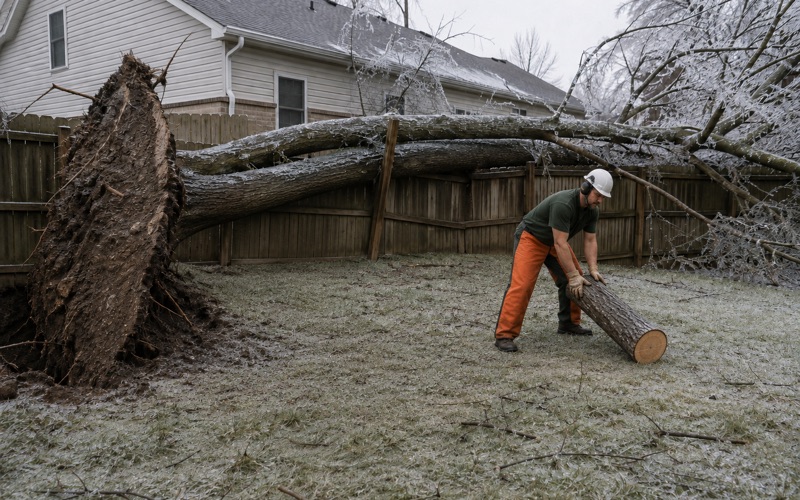
Ice is the loading that generates this work in Williamson County. Winter Storm Fern moved through starting early on Saturday, January 24, 2026 and continued into Sunday with a mixture of snow, sleet and ice. More than 300,000 outages occurred across Tennessee and close to 15,000 across Williamson County by the end of that weekend, downed trees and power lines blocked county roads, and TVA dropped power to some Middle Tennessee Electric substations during the event. Our storm response is planned around that loading and around the straight-line wind this metro actually gets.
What we look at after a load event
A tree that survived an ice load is not automatically a tree that is finished failing. We look for windthrow at the root plate, co-dominant stems with included bark at the union, a conk at the root collar, and hangers still suspended in the crown. Some of that resolves with deadwooding, crown cleaning or a crown reduction; some of it resolves with cabling and bracing. We will say so when a tree can be kept, and we will put the reasoning in writing when the answer is that it cannot.
Conductors, transformers and the No Grow Zone
Middle Tennessee Electric serves the city, staffs vegetation management with certified arborists and holds Arbor Day Foundation Treeline USA accreditation for the program. Its rule keeps vegetation 12 feet clear of the front of a pad-mounted transformer and 3 feet clear of every other side. Anything touching an energized conductor is their crew’s work, not ours, and the number for their vegetation management line is 1-877-414-7685.
Hillside ground, shallow limestone and what the grinder finds
The fourth protected category is geographic. The HP hillside protection overlay district establishes tree protection areas on hillside property in connection with development or alteration, and inside those areas removal needs planning commission approval. Slope, in other words, is what pulls a tree into the permission question that a flat parcel of the same size never triggers.
Underneath all of it is Nashville Basin limestone. The mapped bedrock is the Nashville Group, the Bigby-Cannon Limestone and the Hermitage Formation, of Late Ordovician age. The Bigby-Cannon is a brownish-gray phosphatic calcarenite with even-bedded limestone, 50 to 125 feet thick; the Hermitage is thin-bedded to laminated sandy and argillaceous limestone with shale, 50 to 100 feet thick.
Depth to rock is a per-parcel number
Williamson County’s soil-mapping regulation records depth to rock in inches by soil series, and its worked examples are exactly that specific: the Talbott soil series at 20 to 22 inches to rock on 0 to 5 percent slopes, and Ashwood-Barfield-Rock Outcrops at 10 to 26 inches to rock on 15 to 25 percent slopes. A tracked stump grinder rated to cut 12 to 16 inches below grade is at or near refusal on ground like the first of those. We probe before quoting a grind depth rather than discovering the interface with the wheel, and a quoted depth we cannot reach is a conversation we would rather have standing in the yard than halfway through the cut.
Stair-step rock and the difference weathering makes
The same regulation names five common subsurface rock scenarios, and it calls stair-step or ledge rock the one most typical of hillsides. That is the scenario to expect on a sloped lot here, and it is the one that makes a machine’s footing change unpredictably across a few feet of travel. It also distinguishes rock, meaning unweathered bedrock at a lithic contact, from non-rock restrictive horizons such as weathered rock and saprolite, and notes that the Hermitage Formation is sometimes weathered deeply enough that its limestone bedding planes show in the Cr horizon and the material looks saprolitic. A probe does not always tell the two apart, which is a reason to treat a grind depth as an estimate until the machine confirms it.
Large lots, mature canopy
Residential minimums of two acres in R-1 and one acre in R-2 set the grain of the city, and the practical effect is a lot of mature canopy standing well back from the street. A white oak or a tulip poplar at the bottom of a sloping back yard is a rigging and access problem before it is a cutting problem, which is where the compact tracked equipment and, when the canopy warrants it, crane-assisted removal earn their place.
Construction protection, and the haul-away nobody budgets for
When removal is tied to a build or an addition, the protection standard at 78-513 is wider than the drip line most crews default to. Barriers must be at least four feet high, built of metal or wood to specification, installed before the permit is issued, and extended to one and one-half times the radius of the drip line measured from the trunk. Inside that tree protection zone only hand excavation is allowed, no material may be stored, watering must continue through construction, and root pruning follows the ANSI A-300 standard the code cites. The development standards at 78-512 add that the landscape plan has to identify every existing tree over four caliper inches proposed to be destroyed.
The city then holds a three-year bond, released when an ISA Certified Arborist certifies that the protected trees survived without terminal damage. Three years is a long time to be wrong about a root zone, and it is why a root collar excavation with an air spade, or soil decompaction inside the protected area, is often cheaper than the bond fight it prevents.
Where the wood actually goes
Public Works collects brush once a month from every residential street, using four hydraulic grapple arm trucks that replaced the department’s woodchippers, and it asks residents not to pile brush directly under low-hanging limbs so the arm can lift a pile without damaging the tree above it. The number is 615-371-0080. That service is for resident-generated material; a contractor’s cut is the contractor’s haul, and we quote it that way.
The Williamson County Landfill takes brush at $40.00 per ton. The county’s page states that beginning May 4, 2026 there is no free disposal at the landfill and all incoming loads are charged regular tonnage fees, and that convenience center brush intake is capped at three feet in length from the same date. Disposal is a real line on a removal here, so we put in writing before we start what is included: the stump, the trunk rounds, the grindings and the chips.
A credential you can check
Tennessee issues no trade-specific tree-care or arborist license. A state contractor license is required at $25,000 or more in materials and labor, and the Home Improvement license applies only in counties that adopted it, which Williamson County has not. That leaves ISA certification as the credential a homeowner can verify, and the city’s own code is what makes it the one that counts here. We work to the ANSI A300 pruning standard and the ANSI Z133 safety requirements on every job, and we do not top trees.
- 20+ Years in Middle Tennessee
- Free Estimates
- Written Scope Before We Start