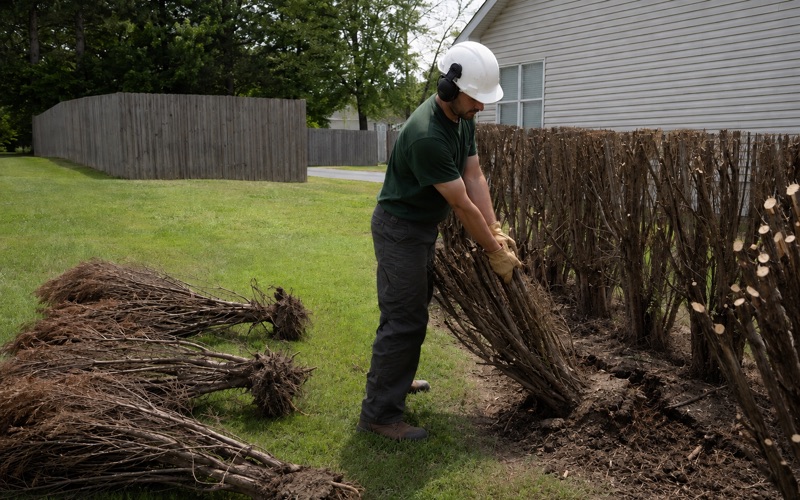
Franklin Tree Removal has spent more than twenty years taking trees down across Middle Tennessee, and tree removal in Columbia is work we plan before we price it. Every estimate we write states plainly what leaves the property and what stays behind: the stump, the trunk rounds, the grindings and the chips. No homeowner should have to guess which of those four is included.
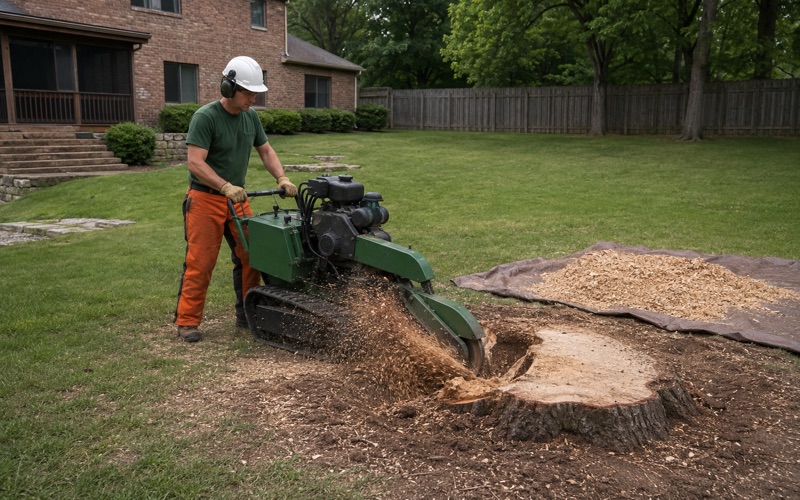
We are a removal company that will argue against a removal when the tree does not need one. If a weak union can be cabled and braced, or a crown reduction buys another decade of shade, we put that in writing and let you decide. When the answer really is removal, we bring the machine the site calls for rather than the one already on the truck: compact tracked equipment through a thirty-five-inch gate for a back-yard tree, crane and rigging capacity for mature canopy on a tight lot.
What follows is what changes about the work on this ground specifically, from the rock the stump sits in to the utility that owns the wire overhead. We would rather set all of it out here than have any of it surface as a surprise once the crew is on site.
Phosphate country, and what the rock under Columbia does to a stump
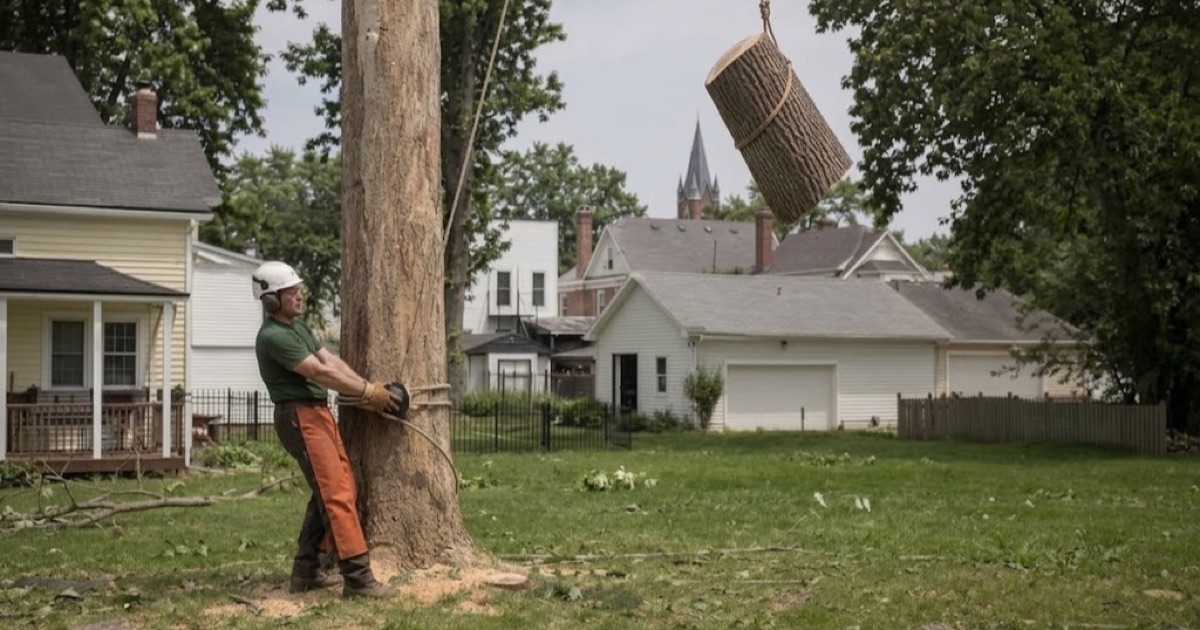
The EPA’s Ecoregions of Tennessee places Columbia and Mount Pleasant in Level IV ecoregion 71h, the Outer Nashville Basin, and states plainly that the limestone here is the limestone that yields commercial phosphate. Geology and industrial history are one fact in this county rather than two: blue rock phosphate was found around Knob Creek north of town in 1891, and the rock that made that discovery possible is the rock a stump grinder has to answer to. Beneath the whole landscape is Ordovician limestone, with the Mississippian-age Fort Payne Formation capping the higher hills.
Deeper residuum than the Basin average
The soil that forms over phosphatic limestone is the Mimosa series, weathered in place into clayey residuum. Its USDA Official Series Description gives solum thickness and depth to rock of 40 to 60 inches, on slopes running from about 2 to 45 percent. A tracked stump grinder rated to cut 12 to 16 inches below grade is therefore working soil rather than stone across much of the city, which is not the case everywhere in the Nashville Basin. It is the practical reason a grind on this ground usually finishes at the depth we quoted.
Where the wheel still finds rock
Depth to bedrock is not uniform, and the same landscape carries Talbott, whose Official Series Description gives solum thickness and depth to bedrock of 20 to 40 inches. On a Talbott mapping unit a grinder can reach refusal inside its rated depth, and we would rather say so while writing the estimate than after the machine is running. The distinction also changes how we read a leaning tree: a root plate that developed over weathered limestone at that depth points to windthrow, not to a decay defect in the stem. On a suspected root-plate failure we look at the ground on the leeward side and at the flare itself before we spend any time in the crown.
Looking for tree removal closer to White Bluff? See Tree Removal Services in White Bluff.
A canopy cohort that reached removal age together
About 23.5 percent of Columbia’s housing units were built before 1960, with the median construction band falling across the 1980s. In the older neighborhoods, where that early stock is concentrated, the shade trees set out with those houses are now past seventy years of age, and in our experience they reach the end of their service lives in clusters rather than one at a time. That is a pattern we see in the work here, not a claim about every street on the map.
Owner-occupancy runs about 63.3 percent of the city’s occupied units, and roughly 10,501 of those are owner-occupied single-family detached homes. That is the housing stock where a shade tree grows tall enough, and close enough to a roof, for its removal to become a real decision rather than a landscaping preference.
What an oak-hickory canopy fails on
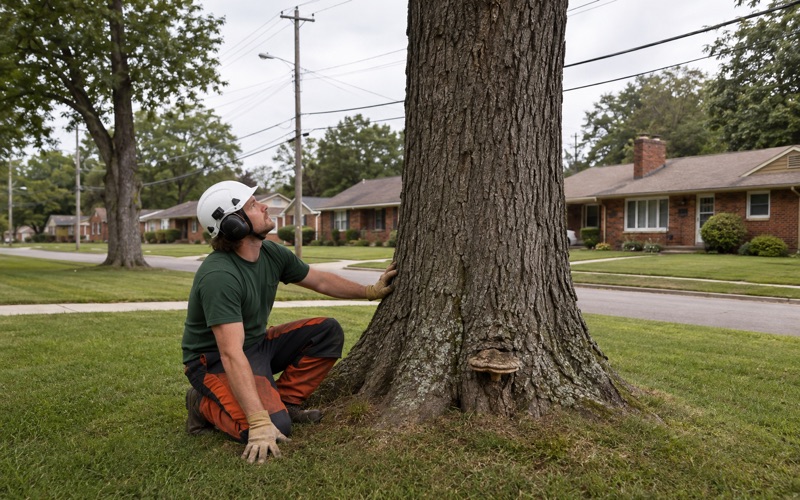
EPA describes the forest of this ecoregion as oak-hickory: white oak, southern red oak, northern red oak, black oak and scarlet oak alongside the hickories, with tulip poplar and eastern redcedar, the state tree and the state evergreen, familiar on residential lots. On a mature specimen we take diameter at breast height, look for a buried root flare, and run a root collar excavation with an air spade when the flare cannot be found by hand. Co-dominant stems joined with included bark, and a conk at the base of a trunk, are the two findings that most often move a tree from the pruning list to the removal list.
The honest answer is often not removal
Crown cleaning, crown raising, deadwooding, or cabling and bracing a weak union will keep a sound tree standing for years, and we say so when that is the recommendation the inspection supports. Pruning we do is worked to the objectives and cut types the ANSI A300 standard defines, and we do not top trees. When removal is genuinely warranted, the tree risk assessment behind that call goes to you in writing, as a document you can hand a neighbor, an insurer, or a reviewer at the city without translating it first.
Columbia Power and Water Systems, and clearance written by the city that owns the lines
The wire over a Columbia street belongs to Columbia Power and Water Systems, a municipal utility operating under the Board of Public Utilities of the City of Columbia rather than a rural cooperative, with its office at 201 Pickens Lane, (931) 388-4833. CPWS publishes its own vegetation standard, and it is not a single number: twenty feet of clearance on each side of distribution lines in non-manicured areas, ten feet in every direction around primary voltage lines in manicured areas, and ten feet around open secondary lines. How the ground beneath a span is kept decides which of those figures governs the tree in front of us.
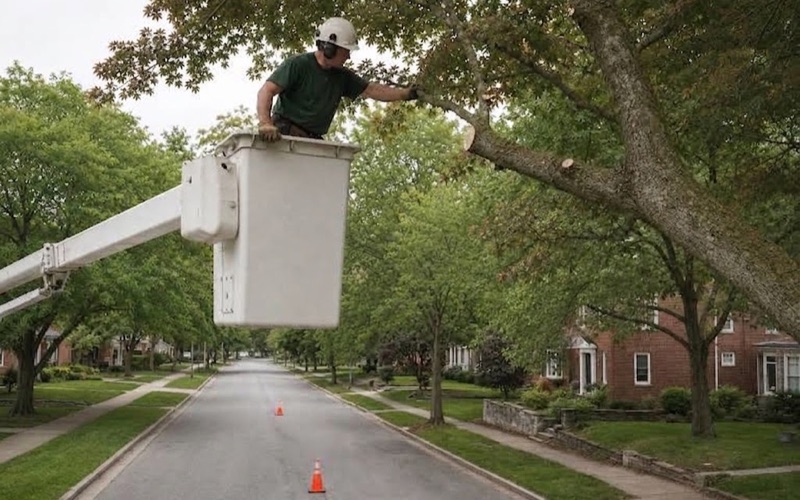
CPWS also allows no woody-stemmed plants within twenty feet of poles and equipment, which settles a question homeowners usually ask us last: what goes back in where the tree stood. Near a pole, replanting becomes a siting decision instead of a free choice, and it is cheaper to hear that before the stump is ground than after something new is planted. We plan the drop zone and the rigging around ANSI Z133 approach distances, and any limb inside the utility’s space is the utility’s call before it is ours.
Downtown’s older core stacks every one of those constraints onto a single parcel: mature street trees, narrow historic lots, overhead runs and city review on the same address. On those streets it is usually access that decides the method, whether the tree is climbed or picked and where the drop zone can sit, far more often than the condition of the tree itself. We would rather walk the approach with you first than find out on the morning of the job that the equipment cannot reach the trunk.
What the city regulates, and what it leaves to the owner
Reading the material Columbia posts, we found nothing standing between a homeowner and a tree in their own back yard. The city tree provisions we did locate are development standards attached to site plan review under Zoning Ordinance 4400, the posted version labeled Zoning Ordinance 4400 April 2025, administered by Development Services and its Planning and Zoning Division. The June 2024 Article 4 text amendment calls for screening by a landscape buffer at least ten feet wide, carrying two canopy trees and two accent trees per hundred linear feet of property frontage, while a parcel inside the historic zoning overlay is reviewed by the Historic Zoning Commission and past the city limits the authority is the Maury County Building and Zoning Office instead.
Credentials, since Tennessee does not license arborists
Tennessee issues no trade-specific arborist or tree-care license, so what stands behind a crew here is the state contractor license threshold, proof of insurance, and voluntary standing as an ISA Certified Arborist. The Tennessee Home Improvement license covering work between $3,000 and $24,999 applies only in the counties that adopted it, and Maury County is not among them. That makes the paperwork a homeowner asks for more important, not less, and we bring ours without being asked.
Storm work in Maury County
Columbia sits in National Weather Service public forecast zone TNZ060, named simply Maury, a single-county zone under the Nashville forecast office with radar coverage from KOHX. That boundary is an administrative line with teeth: a warning issued for TNZ060 covers Maury County and stops at its edges, so the clock on a response here starts on the county’s own zone rather than on a metro-wide alert. Middle Tennessee averages 18 tornadoes a year across 1995 through 2025, against 8 for West Tennessee and 6 for East.
Ice loads the crown, and saturated clay lets go of the root plate
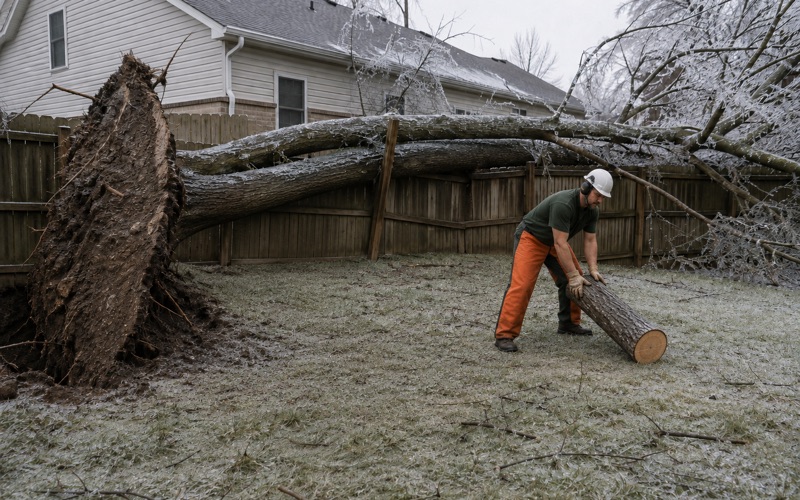
The ice storm of January 25 and 26, 2026 laid down half an inch of accretion or more, broke 444 poles and peaked near 230,000 customers without power statewide. Ice fails a tree by weight rather than by wind, which puts the damage in the crown and over whatever is parked beneath it. Mimosa, by its own series description, is slowly permeable clay, and slowly permeable clay holds water at the root plate long after the rain has stopped, so a tree that stood through the wind can still come over days later.
Wind is the other half of the picture. The June 21, 2019 derecho crossed every Middle Tennessee county with more than 100,000 outages, and the all-time measured gust at Nashville International reached 96 mph on April 1, 1974. Our storm planning is built around ice loading and straight-line wind because that is what this part of the state actually gets, rather than around a generic hurricane script written for the coast.
Getting the wood off the property
Tennessee repealed its emerald ash borer, pine beetle and thousand cankers disease quarantines in 2021, so nothing in state law restricts what we do with wood cut here; disposal is a logistics question. Where brush is burned within 500 feet of forest, grassland or woodland, the Division of Forestry requires a burning permit from October 15 through May 15, issued through BurnSafeTN.org. Otherwise the chipper and the truck take care of it, and the written estimate says up front whether the trunk rounds, the chips and the grindings stay or go.
Estimates are free, and after a storm we will tell you straight whether the job is worth an insurance claim or better handled without one. That answer costs nothing either way, and it does not change if you decide to wait a season before booking the work.
- 20+ Years in Middle Tennessee
- Free Estimates
- Written Scope Before We Start