Franklin Tree Removal runs crane-assisted tree removal in Franklin, TN for the trees that conventional methods cannot take safely, and after more than twenty years working older lots here we know how many of those there are. Mature canopy that outgrew the yard planted under it, dead ash that will not hold a climber, and trees standing where there is simply nowhere for a section to land are the three that come up most.
A crane changes the physics of the job rather than just speeding it up. Instead of lowering pieces through the canopy on rigging that loads the tree itself, the machine takes the weight of each section before the cut is finished and carries it clear. On a tree with compromised structure, that is not a convenience; it is the only method that does not depend on the tree holding together.
It is also not the answer to everything, and we say so on the estimate. A straightforward removal in an open side yard does not need one, and a back-yard tree that our compact tracked equipment can reach through a thirty-five-inch gate should not be priced as a crane job. What we quote is the method the tree actually requires.
When a Crane Is the Right Call
Trees Over a Roof, a Pool or a Drive
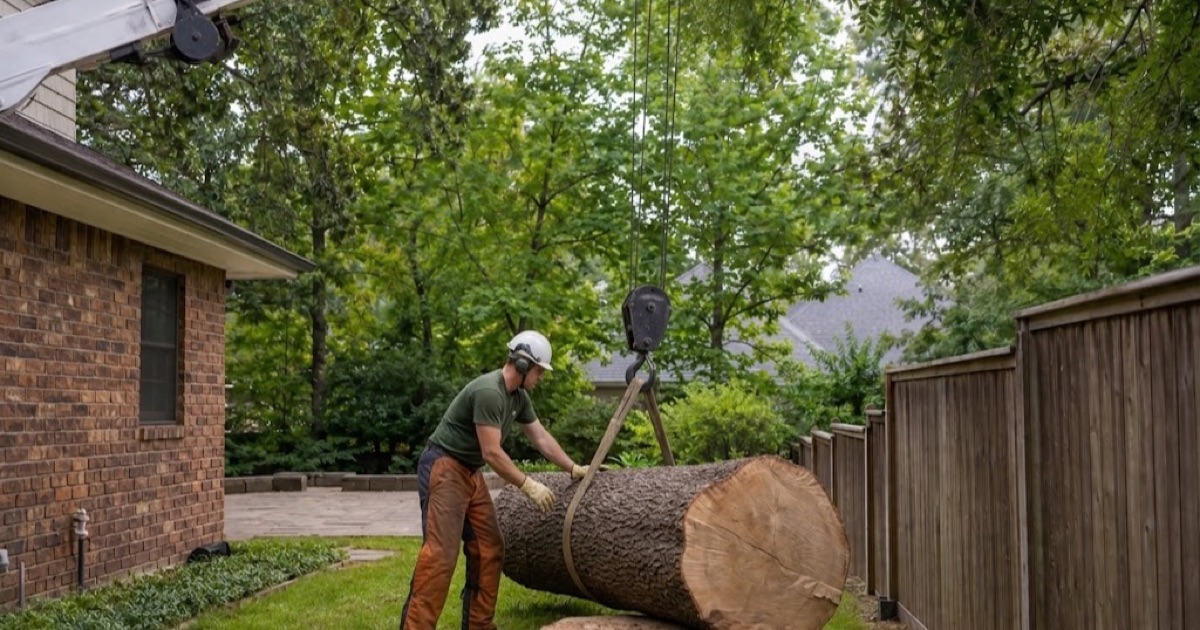
When the drop zone is a structure, every piece has to be under control from before the cut until it is on the ground. A crane holds the section in tension while the cut is completed, then swings it away from the target entirely. That removes the moment conventional rigging cannot eliminate, which is the fraction of a second between the piece releasing and the line taking it.
Dead and Structurally Unsound Trees
A tree that has lost structure cannot be trusted to hold rigging or a climber, and that is precisely the tree people most want down. Borer-killed ash goes brittle and sheds bark; a hardwood with decay through the base can look solid from the outside. Working from the machine rather than from the tree takes the compromised structure out of the safety calculation.
Lots With No Drop Zone at All
On a tight lot with a house, a fence, a septic field and a neighbor’s building all inside the tree’s reach, there may be no direction a section can fall. Conventional removal answers that with many small pieces and many hours. A crane answers it with a handful of large picks landed in a staging area, which is usually less time on site and far less traffic through the yard.
What a Crane Pick Involves
Setup, Outriggers and Ground Bearing
The setup decides the job. We look for a level position within working radius, check what is underneath it, and pad the outriggers to spread loads that would otherwise punch through a driveway or a lawn. Ground bearing matters more here than people expect, because rock close to the surface in one part of a yard and re-worked fill in another can sit within a few feet of each other.
Rigging the Pick
Each section is slung, weighed against the chart for that radius, and cut in a sequence agreed before anybody leaves the ground. The climber or lift operator, the crane operator and the ground crew work to a single set of signals, and nothing is cut until everyone has confirmed the pick. That discipline is what the ANSI Z133 safety requirements are built around, and it is not something to improvise mid-job.
The Landing Zone
A crane job needs somewhere to put what it lifts, and planning that space is half the site logistics. Sections are landed in a staging area clear of the house and the work zone, then processed there with the chipper and saws rather than in the drop zone. It keeps the working area under the boom empty, which is where the real risk sits.
The Alternatives We Try First
Compact Tracked Equipment and Spider Lifts
A great many back-yard trees do not need a crane at all. Our compact machines pass through a thirty-five-inch side gate and travel on their own tracks, and a spider lift sets up on ground a bucket truck could never reach. Where those get the job done, quoting a crane is padding the bid for machinery that was never required.
Conventional Rigging and Lowering Devices
On a sound tree with a workable drop zone, a climber with a mechanical lowering device can take a canopy down in controlled pieces at a fraction of the setup cost. The limit is the tree’s own structure, because that method rigs against the trunk. When the trunk is the thing we do not trust, the method changes.
Access, Neighbors and Scheduling
Street Setup and Right-of-Way
Where the setup has to be on the street, the job becomes a neighborhood event for a few hours and is better handled with notice than with apologies. We confirm the setup position, arrange any traffic control the location requires, and give the immediate neighbors a window. Clear right-of-way access also matters for the chip truck, which needs a working position of its own.
Older Lots and Mature Canopy
The trees that most often need this service are the ones that came with the property: large white oak, tulip poplar and sugar maple planted or left standing decades ago, now much closer to a roof than anybody intended. Those trees are worth keeping wherever pruning or support will do it, and worth removing properly when it will not.
- 20+ Years in Middle Tennessee
- Free Estimates
- Written Scope Before We Start