Franklin Tree Removal has spent more than twenty years on tree removal in Fairview and across Middle Tennessee, working both the Nashville Basin and the Western Highland Rim sides of the metro. Fairview sits on the Rim side, and that decides which species dominate a lot, how deep their roots actually go, and how they come apart when they fail. We price a removal from what is standing on the property, not from a regional average.
Every job starts with a written scope. It says what comes down, what stays, whether the stump is ground, and where the trunk rounds, the grindings and the chips end up before a saw is started. Estimates are free, and we will tell you when a tree can be cabled, braced or pruned to standard instead of taken out.
We also read the rules that apply to the address first. The city’s debris policy puts the haul-off squarely on the contractor, and Fairview replaced its entire land development regime this spring. Both of those change what a removal here costs and how it gets scheduled.
Half a million planted pines, and what ice does to a single-cohort stand
Bowie Nature Park is a 722-acre city park built on ground that was losing over 30 tons of topsoil an acre a year when Dr. Evangeline Bowie bought it in the 1950s. She orchestrated the planting of more than 500,000 loblolly pines, along with terraces, lakes and a hydrology system, and gave the whole property to the city before her death in 1992. That single act of restoration is why so much of the mature evergreen canopy around this city is planted rather than wild.
A plantation does not fail one tree at a time
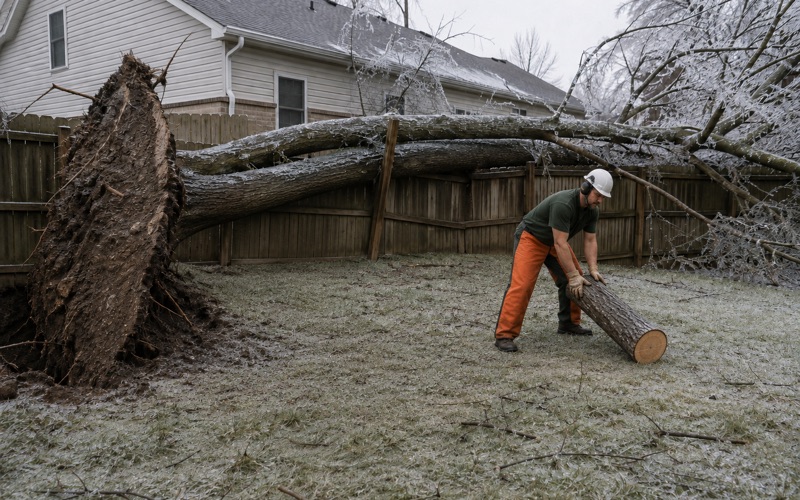
A stand established in one season is one age, one species and one root architecture. Loblolly is shallow-rooted with brittle limb structure, so under an ice load it sheds tops and snaps stems across a whole block at once instead of losing the odd weak specimen. On and around that pine ground we plan storm work for volume and for the sequence of what to take first, because the failures arrive together.
Winter Storm Fern and the January 2026 ice
The National Weather Service office at Nashville logged the storm that began on January 26, 2026 as a major winter event, with ice accumulations of half an inch or more crippling the metro. More than 10,000 outages hit Fairview and western Williamson County as the planted pine came down onto lines and roofs. Fairview sits in public forecast zone TNZ059, a county-wide zone under that same Nashville office, so the warnings arrive for the whole county even when the damage concentrates on this side of it.
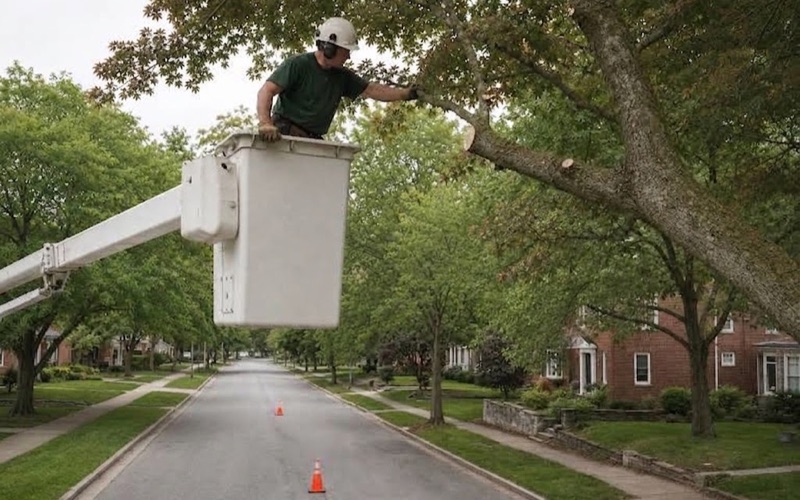
Our storm response is built around the ice loading and straight-line wind this part of Tennessee actually gets, rather than a generic hurricane playbook. Middle Tennessee Electric holds a 40-foot right of way, measured 20 feet on each side of a power line, and its vegetation management crews cut back or remove what grows into it. Anything outside that corridor and over your roof is yours to deal with, and that is usually where we start.
Looking for tree removal closer to La Vergne? See Tree Removal Services in La Vergne.
The Highland Rim escarpment and the fragipan under Fairview yards
A point at the center of the city falls inside EPA Level IV ecoregion 71f, the Western Highland Rim, within Level III ecoregion 71, the Interior Plateau. The boundary between the Rim and the Outer Nashville Basin runs through Williamson County, and Fairview stands on the Rim side of it at 823 feet, roughly 150 feet above Nashville and the surrounding suburbs. Bowie Nature Park describes its own position the same way, on the western escarpment of the Highland Rim at the edge of the Central Basin, and credits that elevation for species not found nearer Nashville.
What a fragipan does to a root plate
The limiting layer on Rim ground is usually not rock. Dickson soils carry a firm, brittle fragipan 18 to 36 inches below the surface, with slow to very slow permeability through it and bedrock deeper than five feet underneath. Water perches on that pan and roots stop at it, so a tree grows a wide, shallow plate above a layer that turns into a saturated slab through a wet winter. That is the windthrow mechanism here, and it is why a trunk that has started to lean after a rainy week is worth a tree risk assessment rather than a wait-and-see.
Chert, and what it costs a stump grinder
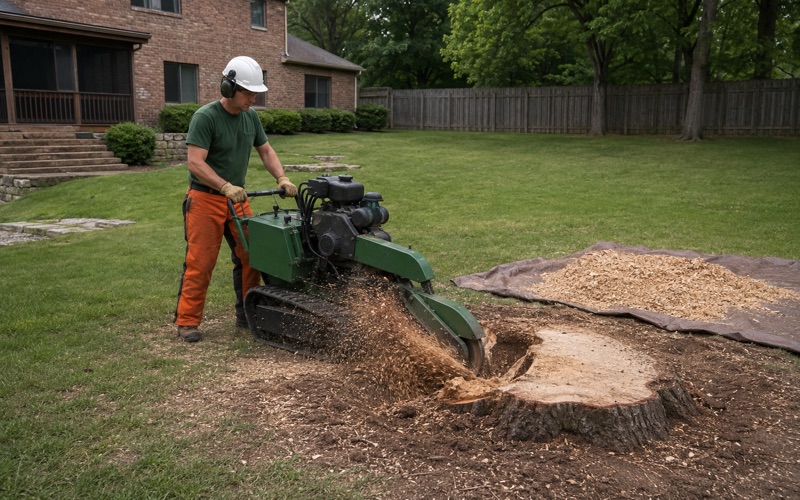
Bodine profiles carry 20 to 85 percent rock fragments in individual horizons and average 35 to 80 percent chert gravel, cobbles and stones through the control section, on slopes from 5 to 70 percent. That much chert will not stop a tracked stump grinder the way solid bedrock does, but it dulls teeth fast and it slows the pass. We quote grinding on this ground knowing that, instead of finding it halfway through the stump and asking for more.
Reading the tree before the removal
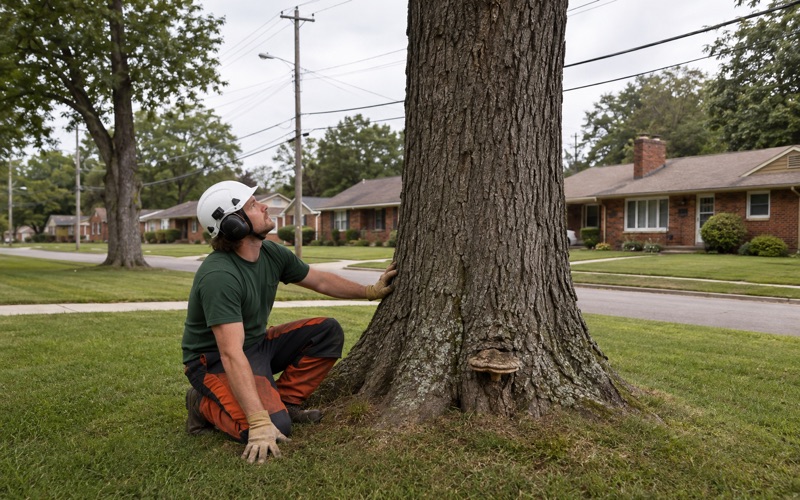
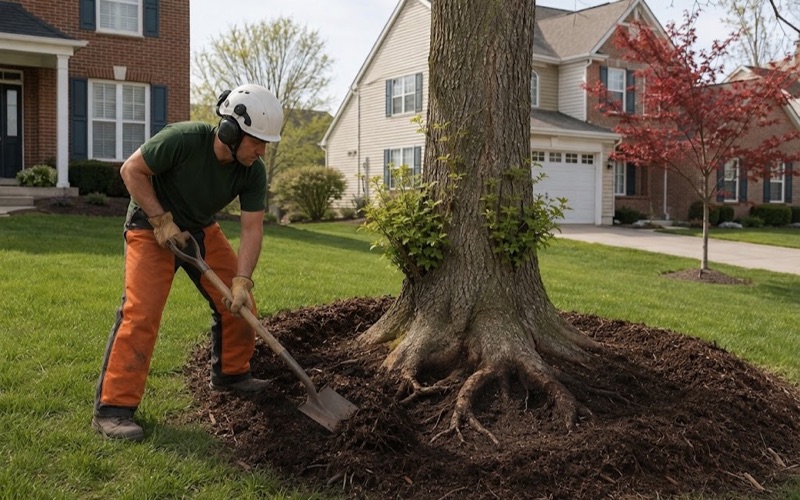
Drier ridges and slopes here carry scarlet oak, chestnut oak, black oak and post oak, with white oak abundant on the broader uplands, while moist north slopes hold beech, maple and tulip poplar. Annual precipitation runs about 50 to 56 inches with a freeze-free period of 185 to 205 days, which is enough growth for defects to get large before anyone notices them. A co-dominant union with included bark in a mature white oak is a different problem from a conk at the root flare, and the two call for different answers. An ISA Certified Arborist looks at the root collar, the union and the crown before a price gets attached to anything.
Debris rules, disposal, and what a hired contractor has to haul
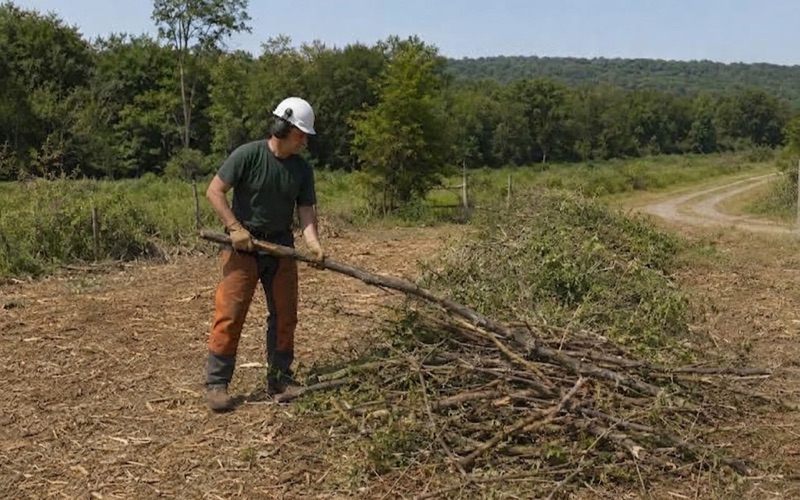
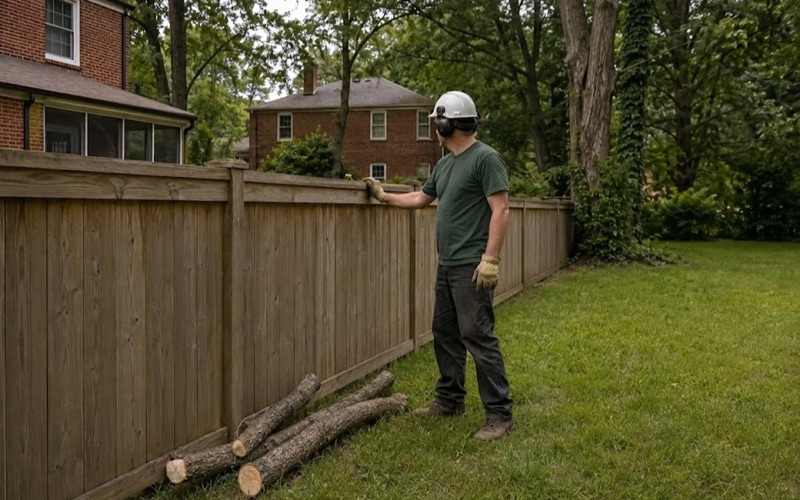
The city’s standing policy is the one that shapes a quote here. A homeowner is responsible for moving material that falls on private property out to the public right of way, but when a resident hires a contractor to do the work, that contractor is responsible for removing all debris, and contractors are not permitted to leave tree limbs or other debris at the curb. There is no curbside route for a tree service in this city. Every round, chip and brush pile our crew creates leaves on our trucks, and the written scope says so before we start.
The contracted storm cleanup has ended
After the January ice storm the city contracted with state bid awarded crews for debris removal, asked residents to place material curbside in the right of way before March 16, 2026, and ran that contract to the end of March. When that emergency contract ended, the city posted that its contracted crews were no longer collecting storm debris around Fairview. Anyone still working through broken pine is doing it without a municipal pickup behind them, which puts the disposal question back on whoever does the cutting.
Where the wood actually goes
County disposal runs through the Williamson County Landfill at 5750 Pinewood Road, Franklin, where brush, clean wood waste and chips are charged a commercial rate of $40.00 per ton. Residents may take up to 5 tons a year at no cost from a primary residence, though beginning May 4, 2026 all incoming loads are charged regular tonnage fees, with free disposal not resuming until January 2, 2027. Convenience centers accept brush only at three feet or shorter, one trip and three cubic yards per household per day. One mature pine crown is many times that allowance, which is the practical reason a removal here is quoted with haul-off included rather than left to the property owner.
The 2026 Development Code, licensing, and access to wooded tracts
Ordinance 2026-02 repealed Fairview’s previous land development regulations and zoning map in their entirety and adopted the Fairview, Tennessee Development Code and a new map in their place. The Board of Commissioners adopted it on April 2, 2026, with staff describing a 470-page document that replaces a 1987 ordinance and moves the city toward a hybrid form-based approach. The city’s own planning and codes page states that the new standards apply to those going through approval or construction after that date.
Check the current code, not an old PDF
Older Fairview code articles are still findable online and no longer govern anything. Any landscaping, buffer, clearing or tree standard that applies to a development site now comes out of the new Development Code, so that is what we check when a removal sits on a parcel in the approval process. On an established residential lot with nothing pending, the practical questions are access, utility clearance and the drop zone instead.
What licensing does and does not cover
Tennessee has no trade-specific tree care or arborist license, so the credential a homeowner asks for has to be something else. The state contractor license applies at $25,000 or more of materials and labor, and Williamson County has not adopted the county-option Home Improvement license, so neither one certifies competence with a rigging line. What is worth asking for is pruning worked to the ANSI A300 standard and its defined cut types, never topping, and ANSI Z133 safety practice on the site.
Acreage, gates and the equipment that fits
Williamson County counted 1,153 farms across 134,957 acres of land in 2022, at an average size of 117 acres, with 541 of them between 10 and 49 acres and 27,768 acres of that land in woodland. That is a landholding pattern more than a farming one: small tracts carrying trees, held by owners whose problem is the tract rather than one specimen. For those we bring a forestry mulcher and work the edge back in a planned line rather than clearing indiscriminately.
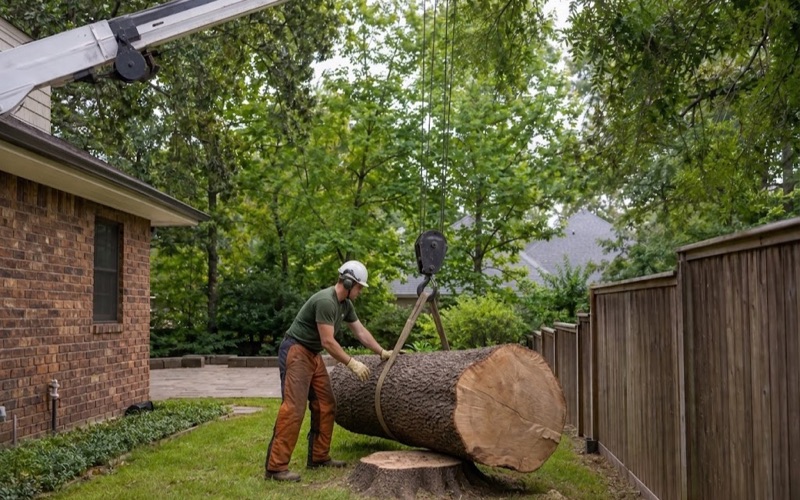
For houses the constraint is usually the gate. Our compact tracked machines pass through a thirty-five-inch opening, so a back-yard removal does not automatically become a crane job, and we keep crane and rigging capacity for the mature canopy standing over an older roof. When you want the reasoning on paper, we write a tree condition report you can hand to a neighbor, an insurer or a city reviewer, and we will give you a straight answer on whether the job is worth an insurance claim at all.
- 20+ Years in Middle Tennessee
- Free Estimates
- Written Scope Before We Start