Franklin Tree Removal has handled tree removal in Forest Hills for more than twenty years, and the first thing we do here is read the ordinance rather than the driveway. Almost every removal inside this city needs written permission before a saw touches the trunk, and that requirement lands on a homeowner exactly as it lands on a contractor. A crew that arrives ready to cut without it is a crew that gets a property owner fined.
So the work starts on paper. We identify what you have, measure it at diameter breast height, say plainly whether it meets the city’s own definition of a specimen tree, and put the condition in writing so an application has something to stand on. Those written reports go to whoever needs them, whether that is a city reviewer, an insurer or an adjoining neighbor.
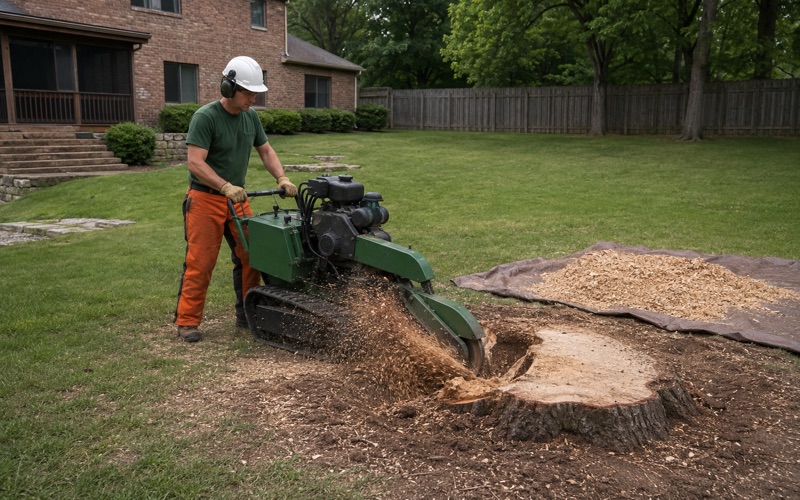
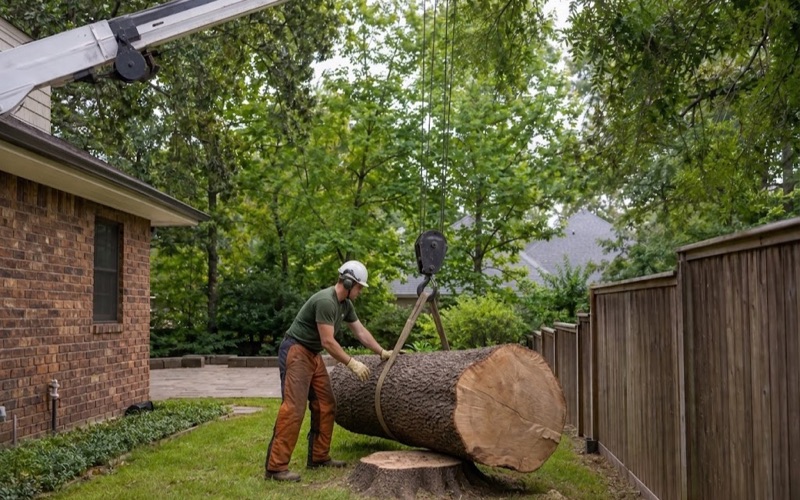
Then we bring equipment sized to the lot instead of the street: compact tracked machines that pass a thirty-five-inch gate, with crane and rigging capacity held in reserve for the canopy that is too large and too close to lower any other way.
The permit that comes before the saw
This city writes and enforces its own zoning ordinance. When Nashville and Davidson County consolidated their governments in 1963, the smaller cities inside the county kept their charters and their own municipal authorities, and Forest Hills still runs under a manager-commission charter with its own Board of Commissioners. The practical consequence is that the tree rules governing your lot were adopted here, by this city, and are enforced by its own officials.
Section 6.05 of the zoning ordinance, Woodland and Tree Protection, is the part that decides your job. It sits at Title 14, Chapter 2 of the municipal code and was last amended by Ordinance 2021-03. Its standards reach newly platted lots, any new residential dwelling, land disturbance requiring a stormwater permit, the removal of a specimen tree from any lot, and timber harvesting or clearcutting.
The city states plainly that a permit is required on most tree removals, and it draws no line between an owner with a rented saw and a crew with a bucket truck. Both need the approval in hand before the tree comes down.
Who signs off, and when they look
The application and the tree replacement plan go to the City Manager, working with the City Arborist, who may be a city agent or an independent Certified Arborist. Nothing issues until conformance with the ordinance is determined, and a submission can be approved, returned for revision or denied. The building inspector or arborist then inspects the site before, during and after the work, confirming the remaining trees were adequately protected and the tree management plan was followed. We set the tree protection zone to match what was filed, not what would be convenient for the machine.
Where disturbance runs past 2,500 square feet, a survey of every tree on the lot has to be prepared and submitted before clearing begins. That is a measuring job, and it costs far less done before a crew is scheduled than after.
Cost, licensing, and the two narrow exemptions
The ordinance provides for a nonrefundable deposit set by the most recent City of Forest Hills Municipal Fee Schedule, while the city separately says its tree permits carry nothing attached. We will not quote you a figure we have not read. The schedule states it, and in our experience the approval, not the paperwork, is the real obstacle.
The exemptions are short: dead trees, and trees already down from a storm or other natural occurrence. Everything else standing runs through the permit. Tennessee licenses no trade-specific arborist, but Davidson County is one of the counties that adopted the state Home Improvement license, so residential work between $3,000 and $24,999 is licensed here, with a state contractor license required above that.
Looking for tree removal closer to Oak Hill? See Tree Removal Services in Oak Hill.
Specimen trees, clearcutting, and the two years behind you
A specimen tree is any tree in fair or better condition measuring 30 inches diameter at breast height for large hardwoods, or 36 inches for large softwoods. Fair or better carries its own definition: a life expectancy greater than fifteen years, a structurally sound trunk, and no major insect or pathological problem. A smaller tree still qualifies if it holds historical significance, including listing on the state Landmark and Historic Tree Registry.
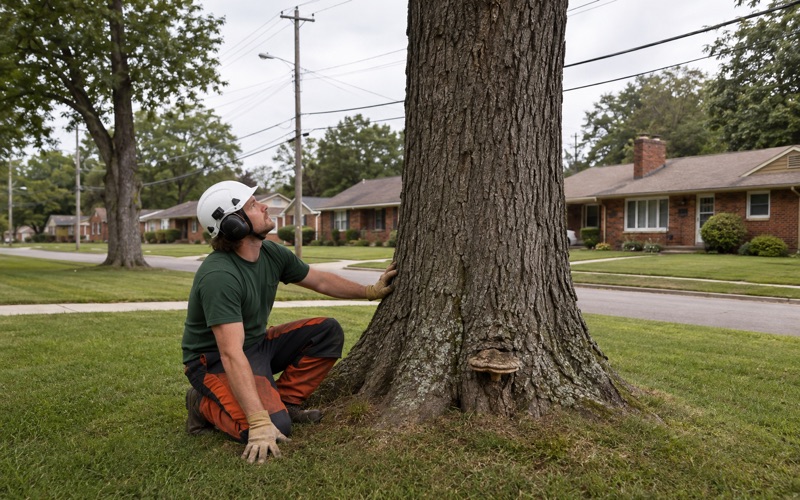
That definition is why we measure and assess before quoting. A large white oak with a conk at the root flare and included bark between co-dominant stems may fail the condition test outright; the same tree sound and vigorous is a specimen, and taking it pulls the whole lot into review. A written tree risk assessment tells you which one is standing in your yard.
The prohibition that attaches to the land
Clearcutting and timber harvesting are prohibited outright here, and the landscaping provisions repeat the prohibition for any lot. Where clearcutting happens anyway, every development approval, rezoning request and land disturbance permit on that property is suspended for three years, running from the time it occurred.
That penalty follows the property rather than the crew that created it. It is why we decline to strip a lot to bare ground no matter how the request is worded, and why a phased plan is worth writing down before the first tree is touched.
The lookback, the replanting, and the daily fine
Retention runs off a table in the ordinance that scales what must stay against how much of the lot trees currently cover. Attached to it is a two-year lookback: a tree removed in the previous two years and not replaced with one of eight inches DBH or greater is counted back into the existing inventory, permitted or not. A removal from two summers ago still shows up in this summer’s arithmetic.
Where disturbance exceeds the retention standards, replanting runs at eighty trees per acre disturbed, or an inch-by-inch caliper replacement. Replacements go in at a minimum of two inches DBH and must be maintained through an establishment period of at least three years; if they do not survive it, new trees are bought and installed and the period resets. Trees that die or are badly injured within two years of a replacement are replaced again at equivalent species and size. Violations run fifty dollars per day, per violation, until remedied.
The clause that changes everything after an ice storm
Section 6.05(j) is the part of the ordinance nobody reads until the worst week of the year. In a natural disaster or other emergency, the City Manager may suspend the provisions of the tree ordinance where they would prevent, hinder or delay necessary action in coping with the disaster. The process that governs an ordinary Tuesday can be set aside on the Tuesday after a storm.
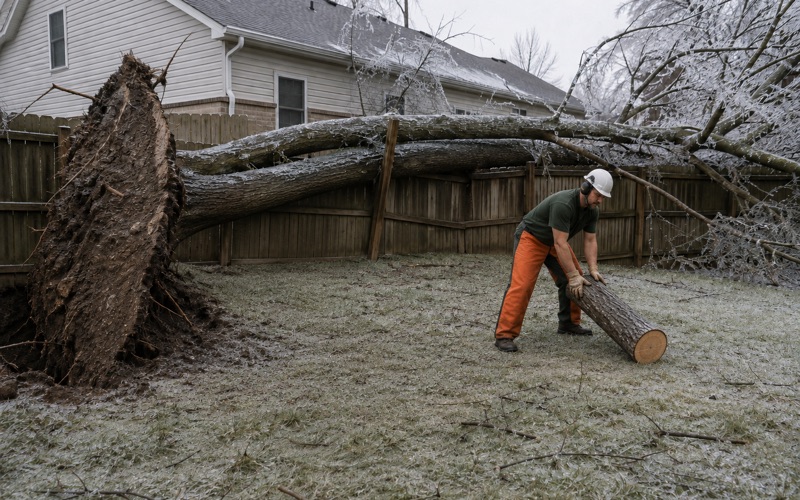
We treat that as a question to ask rather than an assumption to make. Our first call on storm work is about the current state of any suspension, because the answer decides whether a hazard tree comes down this afternoon or waits on a reviewed application. Trees already on the ground sit under the standing exemption either way.
Ice loading is the local failure mode
The storm of January 24 and 25, 2026 is the recent benchmark. Ice totals ran from a glaze to more than half an inch, with a quarter to a half inch typical, power went out to as many as 230,000 households across the Nashville area, and more than 37,000 customers were still dark on February 1. It was reported as the worst ice storm in decades for Middle Tennessee.
Ice does not fail a tree the way wind does. The load is vertical and it lands on horizontal limb structure, on long laterals and on unions that have been left to extend without crown cleaning. We plan storm response around that loading and around the straight-line wind this metro actually gets, rather than a generic script borrowed from the coast.
What the utility is doing overhead
Nashville Electric Service changed its clearance standard after that storm, and the current state of it is easy to get wrong. NES widened the cleared zone from ten feet below the lines to fifteen feet for all species, cut in a horseshoe pattern, and stopped ground-to-sky trimming, leaving lower vegetation and limbs where it can. Metro Council passed a resolution urging a pause on the blanket fifteen-foot rule; NES declined at its board meeting, saying the risk from overgrown trees ahead of severe weather season outweighed the frustration, and noting the areas being cut had gone four years without maintenance. It reported trimming 587 miles of vegetation between July and December 2025; the trimming was not paused.
Chert, slope, and getting a machine to the tree
The city covers a little over nine square miles of steep wooded hills at an elevation of 653 feet, with the Otter Creek watershed running through the south-central section. The zoning code names the ground itself: the Hillside Protection overlay reaches any lot with a portion at 800 feet or above or containing steep slopes, and the open space provisions refuse to count wetland, slopes of twenty percent or more, slippage soils, sinkholes or karst formations. When a city writes karst into its own ordinance, it is telling you what sits under the yard.
Bodine is the most extensive soil series mapped in Davidson County by acreage, mapped there on slopes of twenty to fifty percent: somewhat excessively drained, formed in colluvium and residuum weathered from cherty limestone, more than five feet to bedrock, and 35 to 80 percent chert fragments through the profile. That is why a root plate here can be deep and still poorly anchored, sitting in a matrix of loose rock, and why a tracked stump grinder pays for teeth on ground where bedrock is nowhere near the surface. Mimosa, the clayey counterpart weathered from phosphatic limestone, is well drained but slowly permeable, and saturated clay on a slope under a full crown is the windthrow mechanism in one sentence. These are county and landform mappings, not a reading of your parcel.
Older houses, big canopy, narrow approaches
About 26.8 percent of the housing here was built before 1960, under trees that have had every year since to grow into the roofline. The owner-occupied stock is 96.9 percent of units and 1,737 single-family detached homes, with no single-family attached units in it at all, so every job is a standalone house on its own ground, most often a parcel of one to two acres.
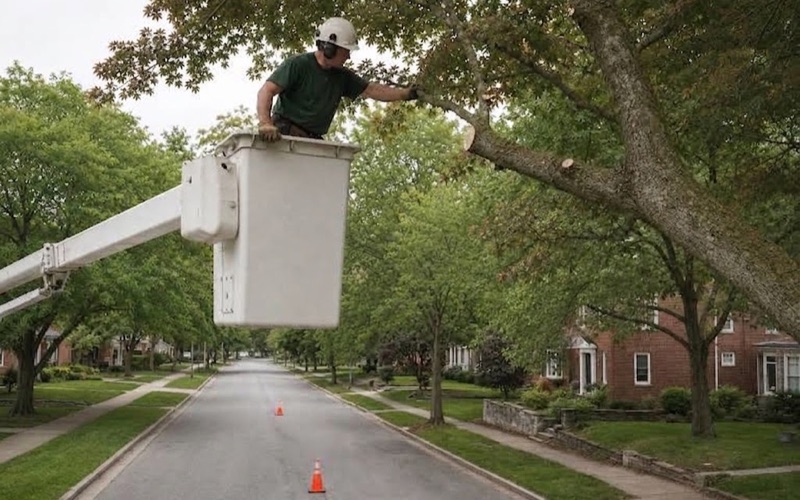
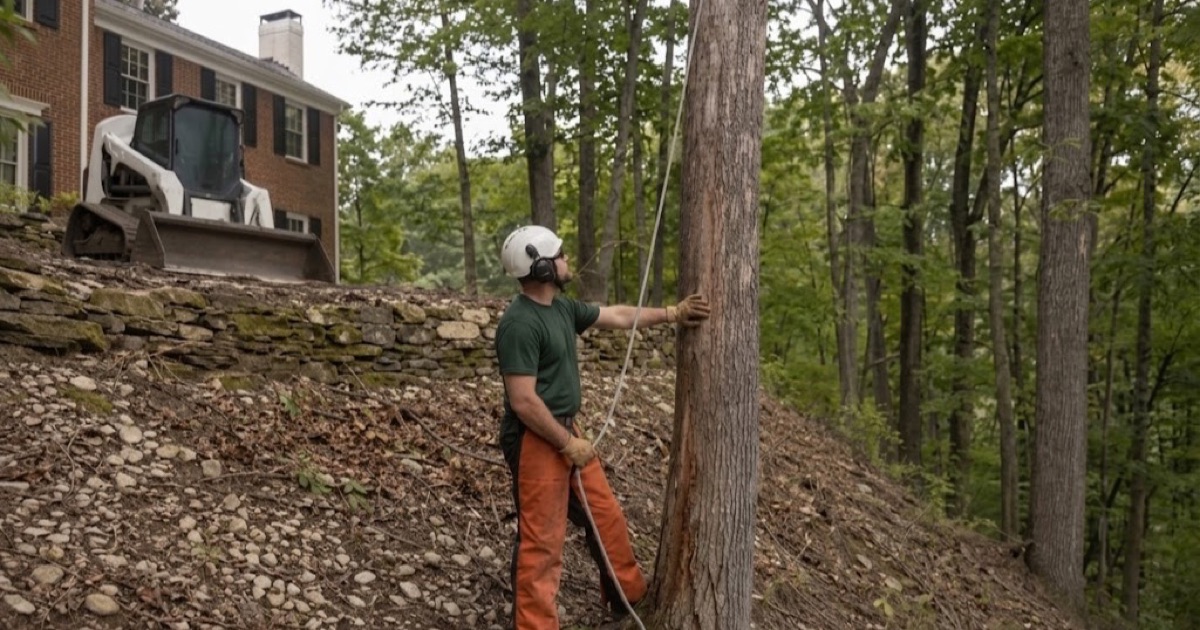
That is what the equipment is chosen for. Compact tracked machines reach a back-yard tulip poplar through a thirty-five-inch gate without a crane closing the street, and crane-assisted removal is there for the mature white oak or eastern redcedar leaning over a roof where nothing else rigs safely. Pruning follows the objectives and cut types the ANSI A300 standard defines, climbing follows ANSI Z133, and we do not top trees. When cabling and bracing or a crown reduction saves a tree, we say so instead of quoting the removal.
Where the debris actually goes
Yard waste, brush, leaves and grass clippings alike, is banned from trash collection across Davidson County, and Metro does not collect brush inside self-incorporated satellite cities. This city fills the gap itself with a free chipping service and monthly leaf pickup through The Parke Company, curbside only, and that contractor cannot come up a private drive.
So the pile matters, and we put in writing before starting what leaves with us and what stays: the stump, the trunk rounds, the grindings and the chips. Estimates are free, and if the job turns on whether it is worth an insurance claim, you get a straight answer on that too.
- 20+ Years in Middle Tennessee
- Free Estimates
- Written Scope Before We Start