Franklin Tree Removal handles tree removal in La Vergne, and we have been taking trees down across Middle Tennessee for more than twenty years, on the Nashville Basin side of this metro and on the Western Highland Rim side. A removal here is rarely just a felling job. It is usually a question of what the tree was counted for on paper, what sits in the airspace above it, and how far a grinder can actually get beneath the stump.
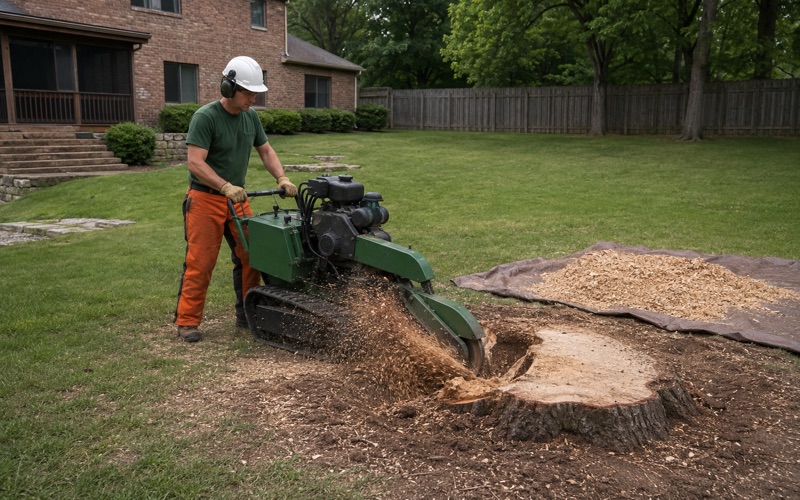
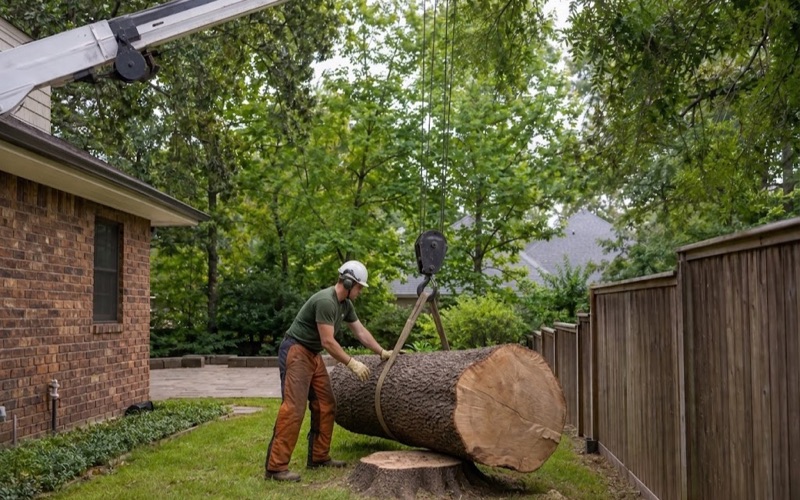
We say in writing what is included before the first cut: the stump, the trunk rounds, the grindings and the chips. Compact tracked equipment fits a thirty-five-inch gate, so a back-yard tree does not automatically become a crane job, and when a canopy genuinely is too large for that we bring the crane and the rigging to match it. Where a tree can be cabled, braced or pruned instead of removed, we will say so, and we will say it before you have paid for a removal you did not need.
We also read the local ordinance before the saw comes out, because the answer changes from one municipality to the next and this one was rewritten recently. That matters most for trees standing on an approved landscape plan, where the wrong pruning cut now arrives with a deadline attached.
Topping a required tree here starts a one-year clock
The zoning ordinance was recommended by the Municipal Planning Commission on July 29, 2025, adopted by the Board of Mayor and Aldermen on October 9, 2025, and became effective October 21, 2025. Chapter 9, the landscaping chapter, is the part that reaches trees, and it is anything but vague about them. It sets one canopy tree of 2.5 inch caliper or two understory trees of 1.5 inch caliper per 25 feet of road frontage, three canopy trees per 100 linear feet of parking perimeter, six large maturing trees and 40 shrubs per 100 linear feet of landscape screen, and it carries a two-page tree specification list.
The replacement clause, in plain terms
Required screening and buffer trees must be kept in their characteristic natural shape. One that has been severely pruned, sheared or topped counts as damaged vegetation in need of replacement, and it has to be replaced within one year. That turns a cheap topping job into a removal, a replanting and a deadline, all of it landing on the property owner. We prune to the objectives and cut types the ANSI A300 standard defines, which means crown cleaning, crown raising, crown thinning and measured crown reduction, and never topping.
No removal permit, which is not the same as no obligation
The same chapter imposes no permit requirement and no diameter threshold for removing an existing tree on private property, and its compliance review is triggered only at submittal of development plans, site plans and preliminary plats. Plant material shown on an approved landscape plan still has to be replaced if it dies, is seriously damaged, or is removed. A homeowner in an established subdivision therefore usually has a free hand, while a tree counted toward an approved plan carries a replanting obligation whether it came down by choice or by storm. New required plantings also carry a 24-month warranty from the installing contractor and a maintenance bond filed with the Planning Director, which is worth knowing before you settle who plants the replacement.
Looking for tree removal closer to Smyrna? See Smyrna Tree Removal.
What sits above the tree: two airport overlays and one right of way
The ordinance carries height zoning overlays for two separate airports whose approach surfaces cross the city, Smyrna Airport under one section and Nashville International under another. These are height rules rather than tree rules, and that is precisely why they reach us: on an affected parcel the cap applies to whatever occupies that airspace, so a canopy left to mature can grow into a limit the landscaping chapter never mentions. The useful conversation on those parcels happens at species choice and at scheduled reduction work, years before anything becomes urgent.
Practically, that changes the removal-versus-retention conversation on those parcels. A tree that will eventually need to come down for height alone is worth planning around now, while it can still be reduced on a cycle or replaced with a smaller-maturing species, rather than after it has become a compliance problem for whoever owns the parcel. We would rather set that out in writing while there are still options than have an owner meet it during a plan review.
Overhead lines and the utility right of way
Where large maturing trees would otherwise be required and overhead utility lines exist, small maturing trees at one per 30 linear feet are substituted with the Planning Director’s approval. That written substitution mirrors what the utility already does on its own side of the line. Middle Tennessee Electric holds a right of way 40 feet wide, 20 feet on each side of the conductor, and its crews cut back and eventually remove what grows into it; around underground equipment its No Grow Zone permits no landscaping within 12 feet of the front of a transformer and 3 feet from every other side.
Sight lines at the driveway
No plants may sit in a sight distance triangle at an intersection or driveway unless an unobstructed view between 30 inches and 72 inches of height is maintained. On a corner lot that is normally a crown-raising job rather than a removal, and raising a canopy to clear the view is the outcome we would rather sell you.
Thin soil over limestone changes what a stump grinder can promise
La Vergne sits in the Inner Nashville Basin, EPA Level IV ecoregion 71i, on flat-lying Ordovician limestone. The natural woody vegetation of that system is dominated by post oak, chinkapin oak and eastern redcedar, with redbud, winged elm, blue ash and hackberry alongside them. The soils formed on clayey residuum weathered from that rock are shallow: the Barfield series, type-located in Rutherford County, runs 8 to 20 inches to limestone bedrock, the Gladeville series about 3 to 12 inches, and the moderately deep Talbott series 20 to 40 inches.
Grind depth is set by rock, not by the machine
A tracked stump grinder rated to cut 12 to 16 inches below grade will often reach bedrock before it reaches the bottom of the root plate. Depth is limited by rock rather than by the wheel, which is why we do not quote a below-grade number sight-unseen; we look at the stump, find the root flare, and tell you what is realistic for that spot before the guard goes down. Grinding and root excavation both count as digging, so the mandatory notice of intent to excavate goes to Tennessee 811 first.
Windthrow, ice and saturated ground
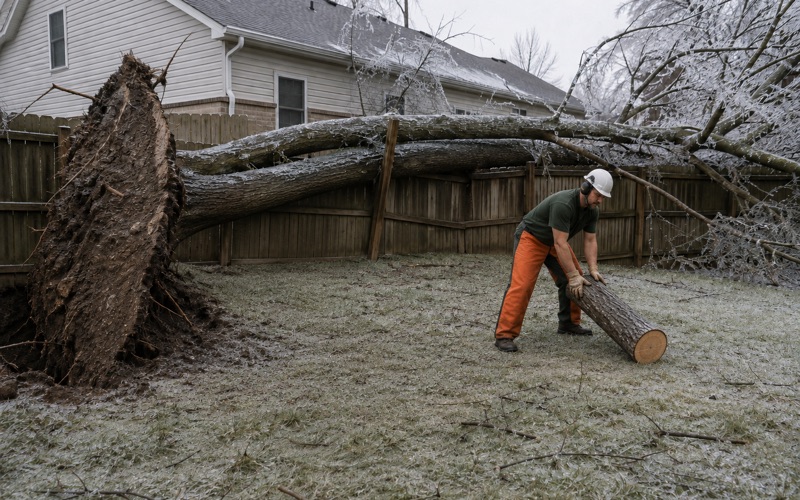
Because rooting depth is capped by rock, a mature tree here spreads a wide, thin root plate rather than a deep one, and that is the mechanism behind whole-tree windthrow in saturated ground instead of a trunk failure. These thin soils dry out through summer and autumn and become saturated through winter and spring, which puts the wettest ground and the ice season in one window.
The Forest Service biophysical model for this glade and woodland system names ice storms, periodic drought, fire and historic grazing as the disturbances that restrict woody growth, so ice loading is documented structure in this ecoregion rather than seasonal color. Over January 24 to 28, 2026, the National Weather Service Nashville office measured 2.1 inches of snow, 0.3 inches of freezing rain and temperatures as low as minus 4 degrees at the Smyrna-Rutherford County Airport, and those are event observations rather than climatological normals. Middle Tennessee Electric’s president and chief executive, Chris Jones, called the restoration that followed one of the most significant challenges in the cooperative’s 90-year history, and described crews finishing a repair only to watch further trees drop onto the same lines as they drove away. We plan storm work around that kind of loading rather than a generic script.
Floodway parcels, warehouse grounds and the houses between them
The ordinance also carries a Floodway Overlay, and the city is bordered by Percy Priest Lake with the reservoir sitting north on the Stones River, so shoreline and floodway parcels are a real category of work rather than an edge case. Those trees are the ones we most often find leaning, holding storm debris, or buried at the root collar by deposited soil, and they are also the ones where access for a chipper or a lift has to be planned rather than improvised.
Distribution and manufacturing campuses
The city carries a substantial industrial base, with Ingram Content Group, the service provider to the book publishing industry, based here. Work on those grounds is shaped by the landscape geometry the ordinance requires: perimeter planting strips averaging at least six feet wide, three canopy trees per 100 linear feet of parking perimeter, and landscape islands at least eight feet wide every ten parking spaces. Crane and chipper positioning on a commercial removal is therefore constrained by island width and truck aprons rather than by open lawn, and we walk it before anything is scheduled. On a campus whose trees were counted toward an approved plan we also put the replacement question in writing at estimate stage.
Residential ground, and young trees reaching size
Housing here is largely owner-occupied, at 74.0 percent by the 2024 ACS five-year estimates, with 8,282 owner-occupied one-unit detached homes. The stock is young: the median build band falls between 2000 and 2009, and only 2.9 percent of units predate 1960. That combination produces streets of yard trees planted with the subdivision and now reaching the size where co-dominant stems, included bark and a buried root collar start to decide whether a tree stays. We give homeowners a written tree condition report they can hand to a neighbor, an insurer or a city reviewer, and a straight answer on whether a job is worth an insurance claim.
Who is licensed to do this work
Tennessee issues no trade-specific tree-care or arborist license at all. The state does require a contractor license for work of 25,000 dollars or more, and separately a Home Improvement Contractor license for residential work from 3,000 to 24,999 dollars in the nine counties that adopted that law, Rutherford among them, where the statutory definition of home improvement expressly includes landscaping. Ask any bidder for that credential and for proof of insurance, and ask whether the crew works to the ANSI Z133 safety requirements. Our estimates are free, and the answer to each of those questions is on ours in writing.
- 20+ Years in Middle Tennessee
- Free Estimates
- Written Scope Before We Start