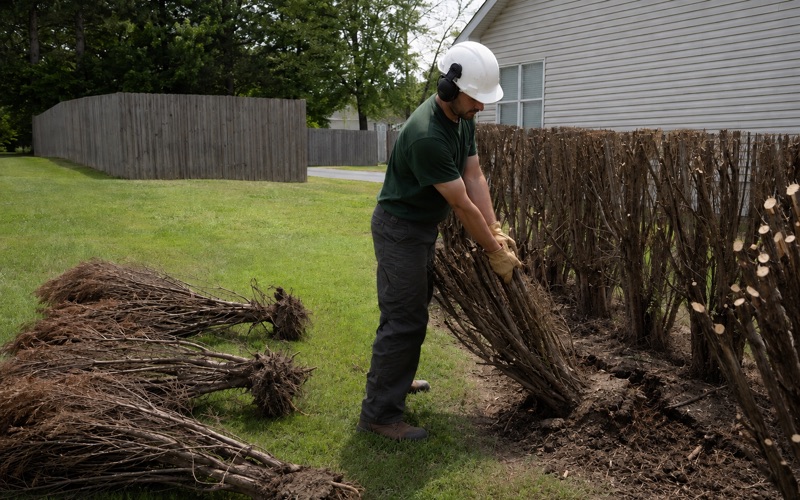
Franklin Tree Removal has handled tree removal in Murfreesboro for more than twenty years, working both sides of this metro from the Nashville Basin across to the Western Highland Rim. A removal in this city is rarely just a saw decision. It is a code question, a utility question and a soil question, usually in that order, and we would rather answer all three before a crew rolls than after.
That is why we read the municipal tree code before the saw comes out. The answer to whether a permit is needed changes from one municipality to the next across this metro, and the ordinance here is one of the more specific ones we work under. It reaches onto private ground in ways most owners do not expect until a notice arrives in the mail.
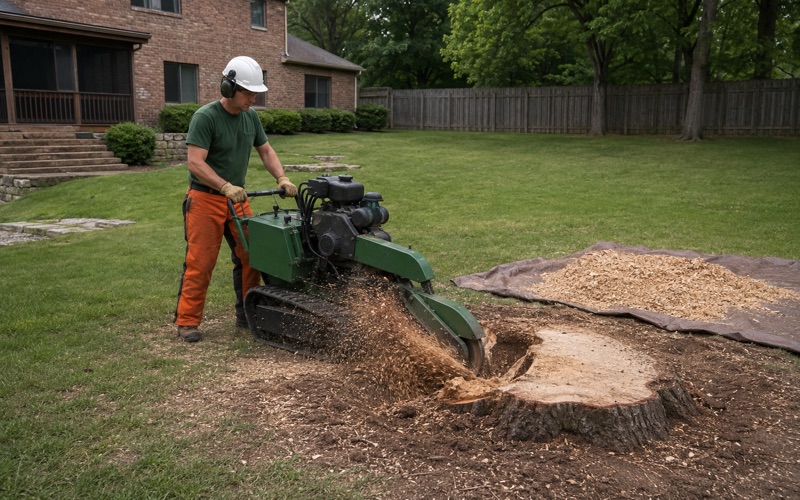
We also put in writing what is included before we start, meaning the stump, the trunk rounds, the grindings and the chips. And we will tell you plainly when a tree can be cabled, braced or pruned to standard instead of taken down. Estimates are free, and so is a straight answer on whether a job is worth an insurance claim.
The clearance rule that reaches onto private ground
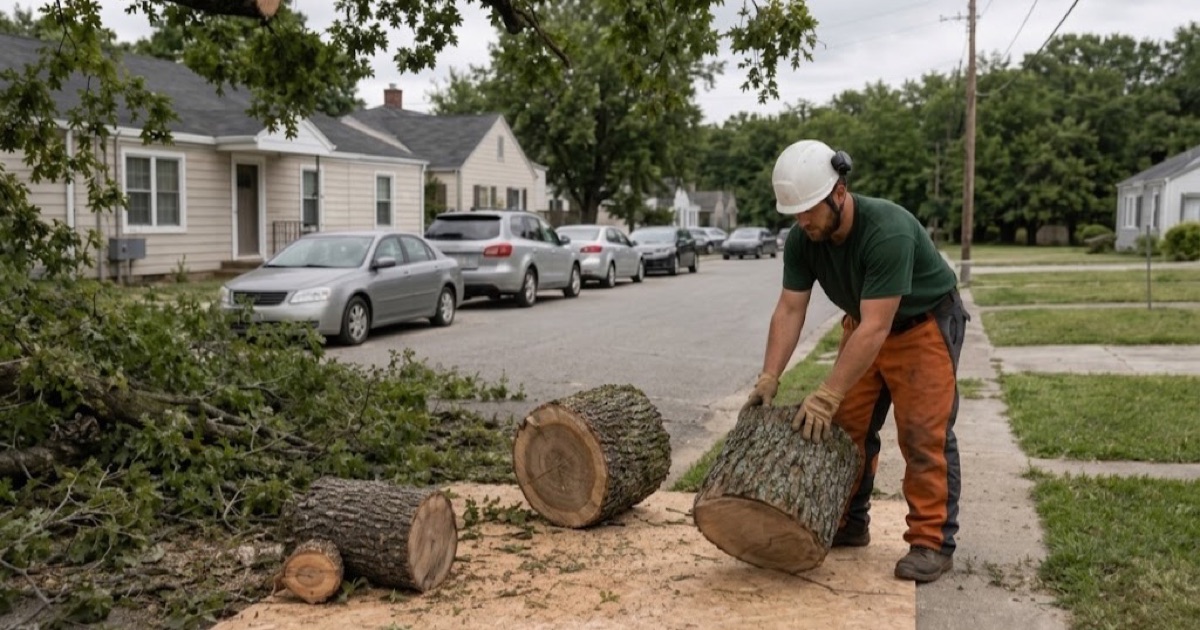
Murfreesboro’s Tree Preservation Ordinance does something many municipal tree codes do not: it declares a public nuisance on private property, not only along the curb. Any tree, shrub or other plant, whether it stands on city-owned property or on private property, that obstructs the free passage of pedestrian traffic below seven feet of clearance, or vehicular traffic below fifteen and a half feet, is a nuisance under the code. Anything obstructing a street light or a traffic sign falls under the same declaration. The city publishes the adopting instrument as Chapter 34, sections 34-1 through 34-10, while the Municode index lists the codified chapter as Chapter 32.5, Tree Management.
Seven feet over the walk, fifteen and a half over the street
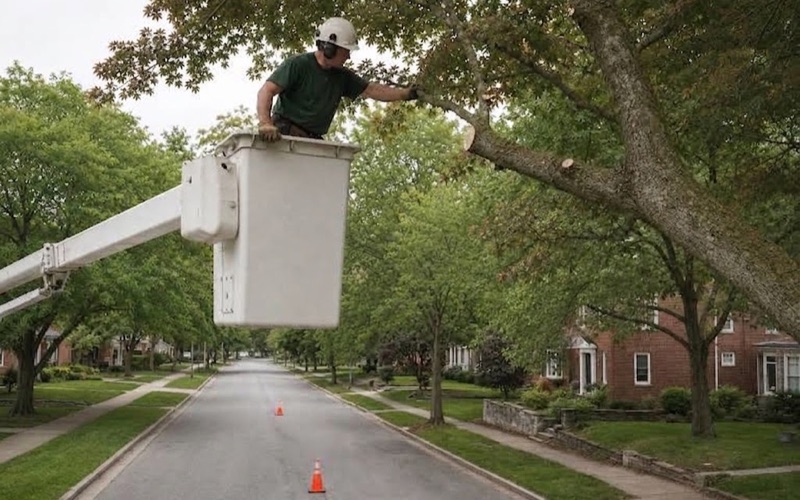
Those two clearances are the working spec for crown raising in this city, and we cut to them rather than to a guess. Crown raising means taking the lower limbs off to open the space beneath the canopy, and under the ANSI A300 pruning standard every cut goes back to a lateral or to the branch collar, never to a stub and never as topping. On a corner lot with a sidewalk that usually means the low scaffold limbs on the street face come off in a single visit. Where a tree cannot give up that much of its lower crown and remain sound, raising it is the wrong answer and we will say so before we start.
When the tree itself is the nuisance
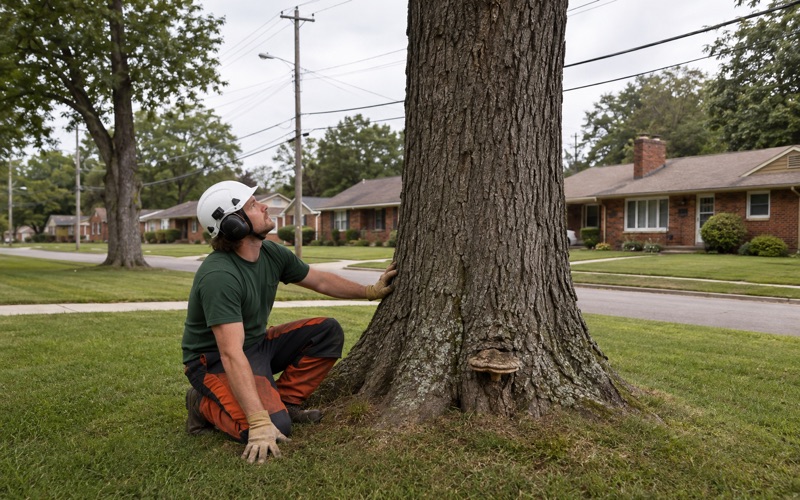
The ordinance separately declares a nuisance any tree that by reason of location or condition is an imminent danger to the health, safety or welfare of the general public, again on city-owned or private ground alike. That provision is what turns a leaning, decayed or lifting tree into something the city can act on rather than a matter between neighbors. We work from a tree risk assessment: the root flare, and where the flare is buried, root collar excavation with an air spade; co-dominant stems with included bark at the union; a conk at the base or on the trunk. What comes out of it is a written condition report you can hand to a neighbor, an insurer or a city reviewer.
Looking for tree removal closer to Ashland City? See Tree Removal in Ashland City.
Thirty days to abate, and what a lien means for the owner
When the city acts on a nuisance tree standing on private property, the ordinance sets out exactly how. Written notice must be served personally or sent by registered mail to the person to whom the last preceding year’s tax bill was sent, and it must allow no less than thirty days for the nuisance to be eliminated. That window may be shortened when there is imminent danger to the public. Owners have a right to a due process hearing before the Tree Board, five citizen members appointed by the Mayor with City Council approval who serve without compensation, and the running of the time limits is suspended from the written request until the Board renders its decision.
If the nuisance is not abated by the date the notice specifies, the city is authorized to abate it, and the reasonable cost of that abatement is filed as a lien against the property. Violation of the tree ordinance is a misdemeanor carrying a fine of up to five hundred dollars and costs, on top of any corrective-action costs the city incurs. Thirty days is enough time to get an estimate, book the work and have it done; it is not enough time to spend three weeks deciding.
Who the notice actually reaches
According to the 2024 five-year American Community Survey estimates for Murfreesboro, 52.4 percent of occupied homes are owner-occupied and 28,900 households rent. Across the calls we take from this city, that split shows up as a gap: the notice travels to the tax-bill address, while the person actually looking at the tree is often a tenant or a manager with no authority to sign for its removal. We are glad to walk an owner or a management company through what the notice asks for, because the abatement clock does not pause while that conversation happens.
The city’s forgivable loan for a hazardous tree
Murfreesboro also runs a hazardous tree removal assistance program, structured as a five-year to fifteen-year forgivable loan to eligible homeowners for the removal of trees that have become hazards. The Community Development Department administers it at 615-890-4660. The city does not publish the fine print, neither the qualifying definition of a hazard nor how the loan is written down over its term, so calling that office directly is the only dependable way to learn where you stand. What we can add is the written condition report documenting the defect, dated and specific, before you make the call.
Permits, Tennessee One Call, and the debris we haul away
The permit provision is narrower than most people assume, and knowing its edge saves everyone a phone call. A permit is required before anyone other than the City Arborist, the Arborist’s designee or a contractor employed by the Arborist may plant on city-owned property, or treat, prune, remove or otherwise disturb any tree, shrub or plant located on city property. It does not place a permit on a yard tree standing well inside your own property line; the ordinance reaches private ground through the nuisance and abatement route instead. The treelawn is the strip owners trip over, since no property owner may remove a tree from it without first procuring a permit, and the owner bears the cost of removal including the stump, the clean-up and the replacement.
The forty-eight-hour lead time and the locate
Applications must be made not less than forty-eight hours before the work is to be done, and the applicant must give a Notice of Intent to Excavate to Tennessee One Call under T.C.A. 65-31-101 and following. The ordinance names that duty explicitly, and it reaches stump grinding and root excavation rather than planting alone, which matters because grinding is the part of a removal that goes underground. The permit itself is issued at no cost and carries a definite expiration date, a violation of its terms renders it void, and a notice of completion must follow within five days of the completion date so the work can be inspected; the City Arborist supervises or inspects work performed under a permit and holds International Society of Arboriculture certification as a condition of the post.
Hauling off what we cut
The City of Murfreesboro states on its own tree services page that anyone contracted to perform tree services is also required to haul off the debris they create, according to city ordinance. We could not find a section number for that duty inside the published ordinance text, so we treat it as the city’s own published statement rather than as a citation, and we work to it either way. You will see tree work advertised around this county that leaves the trunk rounds stacked on site at no charge, and for an owner with a wood stove that is genuinely useful. What we will not do is leave the wood there by default and describe it as a saving.
Shallow limestone ground and what it does to a tree
The city sits in the Inner Nashville Basin, EPA Level IV ecoregion 71i, over flat-lying Ordovician limestone. The natural woody vegetation of that ecoregion is dominated by post oak, chinkapin oak and eastern redcedar, with redbud, winged elm and blue ash among the associated species. The limestone cedar glades at Stones River National Battlefield are the reference example inside the city, and the National Park Service describes them in zones of soil depth: exposed rock with no soil, gravel glades holding up to two inches, zones of two to eight inches, and forested ground carrying more than twelve inches.
Grind depth is set by bedrock, not by the machine
Soils here form on clayey residuum weathered from limestone and they are thin. The Barfield series, type-located in Rutherford County, runs eight to twenty inches to limestone bedrock; the Gladeville series about three to twelve inches; the moderately deep Talbott series twenty to forty inches. A tracked stump grinder rated to cut twelve to sixteen inches below grade will meet rock on a Barfield or Gladeville profile long before it reaches the bottom of the root plate. That is why we do not quote a below-grade grind depth sight-unseen on this ground: the rock sets it, not the wheel.
Windthrow, ice, and the January 2026 storm
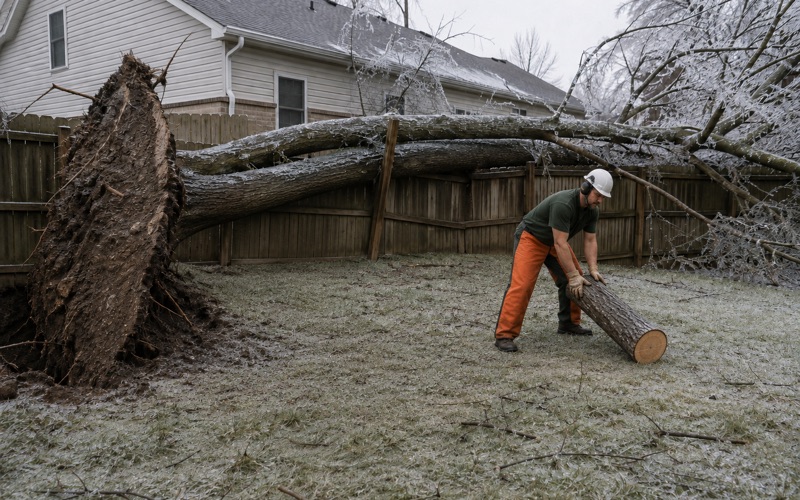
Because rooting depth is capped by rock, a mature tree here spreads a wide, thin root plate rather than a deep one, and that is the mechanism behind whole-tree windthrow in saturated ground rather than a trunk snapping. Those thin soils dry through summer and fall, then saturate through winter and spring, which puts the wettest ground and the ice season in one window. The USDA Forest Service biophysical setting model for this system names drought, fire, historic grazing and ice storms as the disturbances that hold woody growth back, so ice loading is a documented structural agent here rather than regional color.
The winter storm of January 24 to 28, 2026 brought Rutherford County 2.1 inches of snow and 0.3 inches of freezing rain, with temperatures as low as minus 4 degrees, measured by the National Weather Service Nashville office at the Smyrna-Rutherford County Airport; the Sheriff’s Office documented 32 downed power lines. Middle Tennessee Electric’s president described the restoration as one of the most significant challenges of the cooperative’s 90-year history, with crews finishing a repair and then watching further trees come down on the same lines as they drove away. Those are observations from one event rather than climatological normals. Our storm planning is built around that loading and around straight-line wind, not a generic hurricane script.
Middle Tennessee Electric holds a right of way forty feet wide, twenty feet on each side of the line, and manages the vegetation within it. The tree in your yard leaning toward that corridor is still yours, and the same is true of the one over your sidewalk. We would rather look at both with you now than meet the second one on a thirty-day clock.
- 20+ Years in Middle Tennessee
- Free Estimates
- Written Scope Before We Start