Franklin Tree Removal has handled tree removal in Nolensville and across Middle Tennessee for more than twenty years, and the question homeowners here open with is usually the wrong one. Most people ask what the town wants signed before a tree can come down. In Nolensville the tree ordinance is written around construction, not around ownership.
Subsection 6.1.4(D) of the zoning code attaches to site plans, subdivisions, land disturbance and grading permits. Nothing in it reaches a homeowner on a finished lot who wants a leaning hackberry taken out of the back yard. That distinction is worth stating plainly, because towns a few miles apart in this county answer the same question differently, and we read the ordinance that governs the address before the saw comes out.
What we put in writing is the job itself: the stump, the trunk rounds, the grindings and the chips, and who is hauling each of them off the property. On the development side of town there is a second set of paperwork, and it is worth knowing what it actually asks for.
Where the ordinance starts: the lot next door under a grading permit
The Town of Nolensville Board of Commissioners adopts and administers the zoning code that governs tree retention, tree inventory and tree replacement, and the grading permit is what those standards hang from. The Nolensville Planning Commission reviews the site plans and subdivisions where they get applied. A crew working ahead of a builder is inside that ordinance. The same crew taking a tree out of a settled yard three streets over generally is not, and conflating the two is the easiest way to describe this town wrongly.
Five inches, measured four and a half feet up
Ordinance 22-10 lowered the tree inventory threshold from eight inches DBH to five, measured four and one-half feet above natural grade, for single-family residential and non-single-family development alike. Every existing tree at or above that diameter inside an area to be disturbed has to be located, measured and plotted, with its species given and its health condition recorded as poor, fair or good, along with contact information for the professional who made that determination.
Trees of twenty-four inches or greater are to be preserved if possible, and existing tree coverage serving as a buffer is not to be disturbed at all. The plan carrying that inventory has to be prepared by a licensed landscape architect, so on a development job the drawing we work from is somebody else’s stamped document. Our part is matching what is tagged in the field to what the plan protects, working from diameter at breast height and the root flare rather than from a spray-paint mark, and keeping equipment outside the tree protection zone.
A written condition report, not an opinion
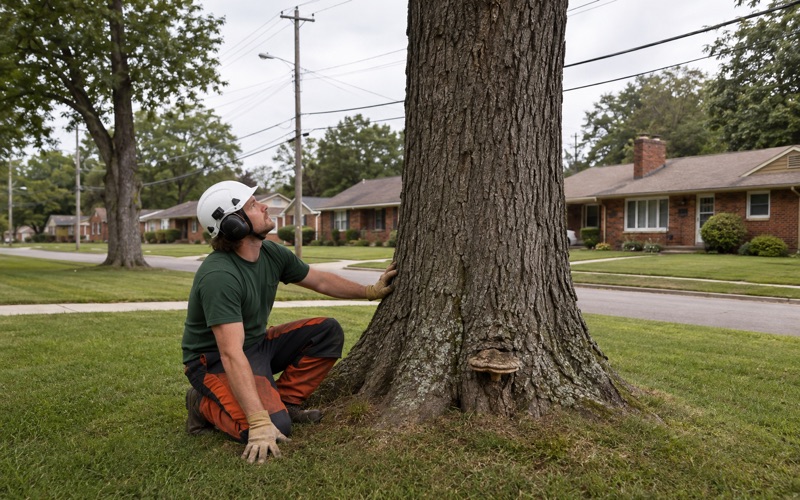
We write tree condition reports a homeowner can hand to a neighbor, an insurer or a town reviewer. On a lot under development the same report is what explains why a tree an inventory called fair had to come out, with the conk, the included bark or the pair of co-dominant stems described and located instead of asserted.
Where the question is whether a tree stays at all, the write-up follows a structured tree risk assessment: what sits under the tree, how likely the part is to fail and reach it, and what happens if it does. A reviewer can argue with that, which is the point. It is also the method we use to justify leaving a tree standing.
Looking for tree removal closer to Forest Hills? See Tree Removal in Forest Hills.
Two inches of caliper planted for every inch removed
Where a tree does come out under the ordinance, replacement runs at two inches of caliper planted for every one inch removed. Absent Planning Commission approval, a removed tree of five to ten inches caliper is replaced with a tree of at least two inches caliper, and a removed tree greater than ten inches caliper with one of at least five inches caliper.
A developer may pay the estimated cost of those replacement trees into a Tree Save account the Town holds rather than planting them, and the Planning Commission holds the discretion to waive or vary the ratios and to accept that payment. Where the tree provisions conflict with anything else in the zoning code or the subdivision regulations, the ordinance says the provision requiring greater retention of mature trees is the one that applies.
The five-hundred-dollar line
Removing a tree in violation of the terms of a grading permit carries a fee of five hundred dollars per tree, paid into that same account. Before the grading permit issues, the applicant pays for a third party the Town hires to inspect the site after grading and confirm that no tree designated for preservation was taken.
That is an inspection with a number attached to a mistake, and it is why on a development job we want the protected trees flagged, the access route agreed and the drop zones walked before anything tracks onto the lot. A removal that was never in dispute is cheap. A removal argued about after the grading is finished is not.
A canopy that went in with the houses
Nolensville’s housing stock is new: 1.1 percent of units were built before 1960 and 6.6 percent before 1980, with the median build band falling between 2010 and 2019. Owner-occupancy runs 93.6 percent, across roughly 4,097 owner-occupied single-family detached homes. Most of the trees standing in those yards were planted with the house, and a fair number are now reaching the age where the first removals happen.
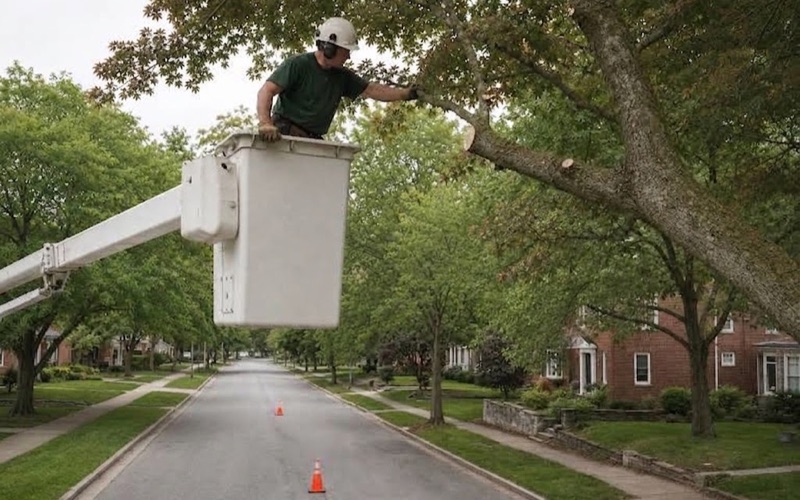
That shapes what we get called for. The failures here are the ones nursery stock grows into: a Callery pear splitting at a crotch full of included bark, a row of Leyland cypress set too close on a property line and browning from the inside, a maple carrying two co-dominant stems that wanted a structural cut a decade ago. Where a tree can still be kept we say so, and cabling and bracing, crown cleaning or a crown reduction worked to the objectives and cut types in the ANSI A300 standard often buys years. We do not top a tree to shorten it.
Where the trunk meets the ground
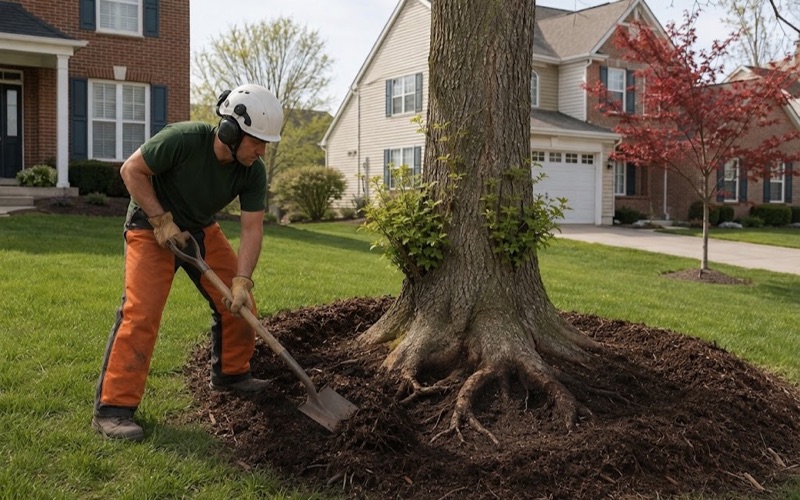
A fair amount of what goes wrong on a new lot goes wrong below the mulch. Nursery stock set an inch or two too deep, or buried by grading and then mulched over again every spring, ends up with its root collar out of sight and girdling roots tightening against the trunk where nobody is looking. We open that up with an air spade rather than a shovel so the roots survive the inspection, and where construction traffic has packed the soil around it, the same tool handles soil decompaction without trenching through what is left. It is worth doing while removal is still one option among several, because on a tree this age it usually is.
Stump grinding on the terrace and on the upland
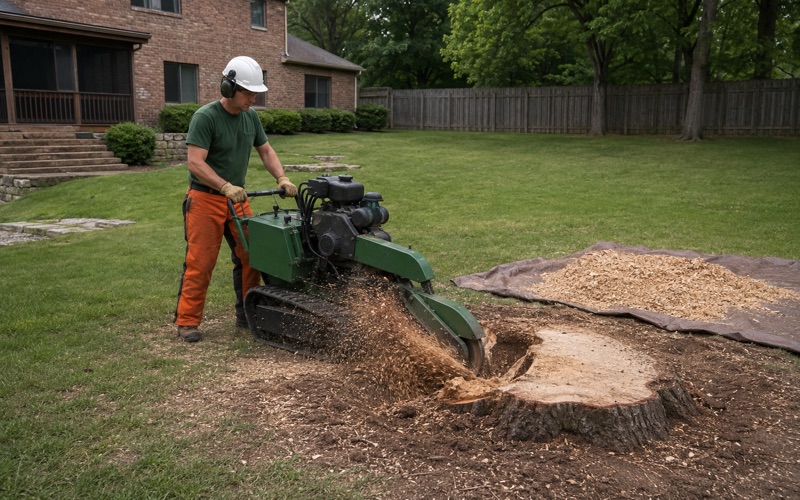
The town was built along Mill Creek, the terrain is mostly flat with a few hilly areas, and the elevation is about 620 feet. On the flat ground the working soil is Armour silt loam, a well-drained fine-silty series formed in old alluvium, valley fill or alluvium over limestone residuum, with bedrock more than five feet down. A tracked stump grinder cutting twelve to sixteen inches below grade is in soil the whole way there.
On the limestone uplands it reverses. Talbott is a clayey residual series whose solum and depth to bedrock run twenty to forty inches, so the same machine on the same quoted job can be into weathered limestone before it finishes. Bodine, the most extensive series mapped in Williamson County by acreage, carries thirty-five to eighty percent chert fragments, and chert in that volume is what dulls a wheel rather than depth to rock. We ask where the lot sits before we price a stump, and we say in the quote how deep the grind goes and whether the grindings stay.
Compact tracked equipment gets us through a thirty-five-inch gate, so a back yard with no side access does not automatically turn into a crane job on a street that was not built for one.
Storm work, line clearance and where the wood goes
Middle Tennessee averages eighteen tornadoes a year across the 1995 to 2025 record, and the June 21, 2019 event was classified by the Storm Prediction Center as a derecho that crossed every Middle Tennessee county. Tropical systems are not a meaningful driver of tree failure here, so we plan storm response around the straight-line wind and the ice this metro actually gets rather than a generic script.
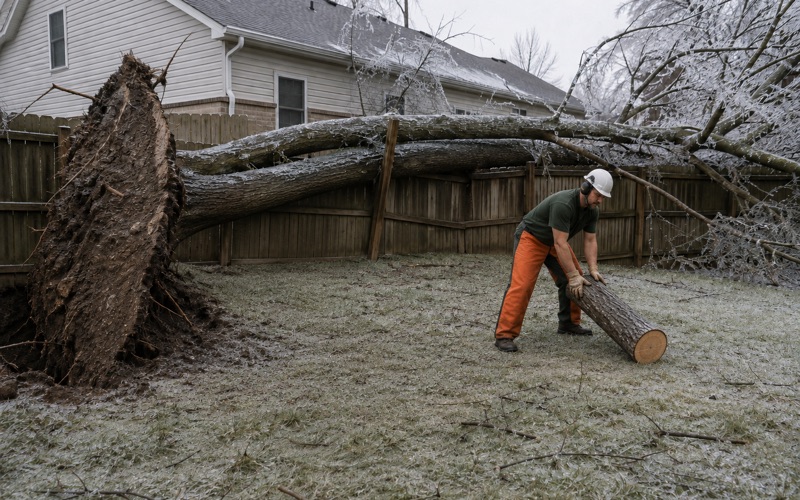
The January 24-25, 2026 storm laid a quarter to a half inch of ice and more across Middle Tennessee and was reported as the worst in decades for the region. Ice does not fail a tree the way wind does. It loads wide, horizontal, poorly attached limbs until they peel, which on planted yard stock usually means the lowest heavy branch over a roof, a fence line or a driveway.
The follow-up work after a storm matters as much as the emergency call. Deadwooding and crown raising over a roof line take the loaded limbs out of play before the next event, and a tree pushed over at the root plate by windthrow is a different decision from one that snapped a leader and kept its roots. We say which of the two we are looking at before anyone talks about price.
The right of way is not ours to cut
Middle Tennessee Electric is the electric provider for the town, and the Town of Nolensville directs residents to the cooperative for service. MTE clears a forty-foot right of way, twenty feet on each side of the line, cutting trees back or eventually taking out the ones standing inside it, and it runs its own right-of-way contractor network reachable at (877) 414-7685. A tree in that corridor is their call, and we would rather tell you that than quote work that is already somebody’s program.
Hauling, disposal and who you are hiring
Brush and clean wood from a residential job go to the Williamson County Landfill or the county convenience centers; the Town runs no landfill of its own. Brush delivered to a convenience center has to be three feet in length or less. Free disposal at the landfill is suspended from May 4, 2026 until January 2, 2027, with all incoming loads charged regular tonnage fees, so hauling is a line we price openly instead of burying it.
Tennessee has no trade-specific tree-care or arborist license. A state contractor license is required at twenty-five thousand dollars and above, and the Home Improvement tier that covers smaller residential work applies only in the counties that adopted it, which Williamson County did not. That leaves insurance, references and a written scope as the things worth asking for. Our estimates are free, and if a job is not worth an insurance claim we will say so.
- 20+ Years in Middle Tennessee
- Free Estimates
- Written Scope Before We Start