Franklin Tree Removal has been doing tree removal in Oak Hill for more than twenty years, working both the Nashville Basin and the Western Highland Rim sides of this metro. Most of what we get called out for here is not a storm emergency. It is a homeowner standing under a yard tree that has quietly outgrown the house it was planted beside, asking whether it is still sound and whether the city will let it come down.
The second half of that question carries more weight here than people expect. Oak Hill administers its own municipal code, zoning and tree removal permit, so what a friend was told about a tree elsewhere in Davidson County does not transfer to this parcel. We read the code that governs the address before we price the job, because the permit answer changes from one jurisdiction to the next across this metro.
What follows is the part of the work that belongs to this ground: a canopy that is aging all at once, a retention standard written as a percentage, a frontage rule with a hard number on it, slope regulations that decide where a machine can stand, and a chipping program that gives the wood somewhere to go.
A canopy planted with the houses, aging out on one schedule
The housing here is old and unusually uniform. Some 58.0 percent of units were built before 1960 and the median unit falls in the 1950-59 band, ninety-five percent of the stock is owner-occupied, and roughly 1,699 units are owner-occupied single-family detached homes. The yard trees planted with those houses went in within a few years of one another, which means they are not aging as individuals. They are a cohort, and they reach removal age together.
What that looks like from the driveway
A street can hold steady for a decade and then produce three or four removals in two winters, and none of them is a surprise once you know the build dates. The species carrying that canopy are the Outer Nashville Basin’s own: white oak, northern red oak, tulip poplar, sugar maple, shagbark hickory and eastern redcedar, growing over phosphate-rich limestone residuum.
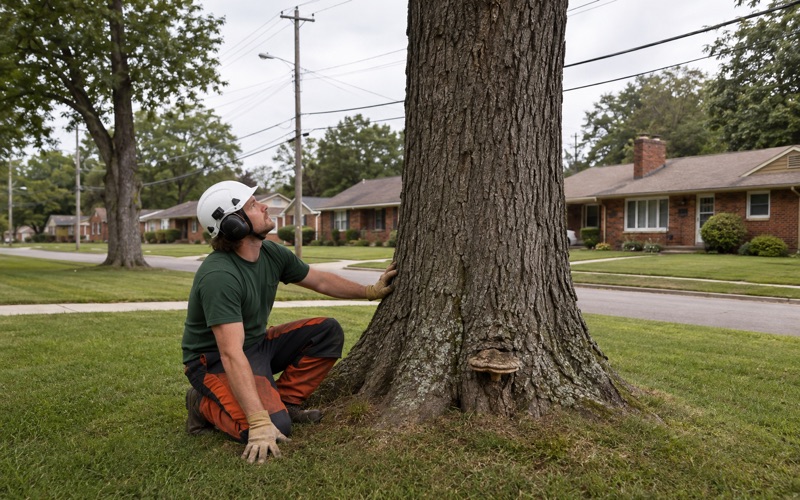
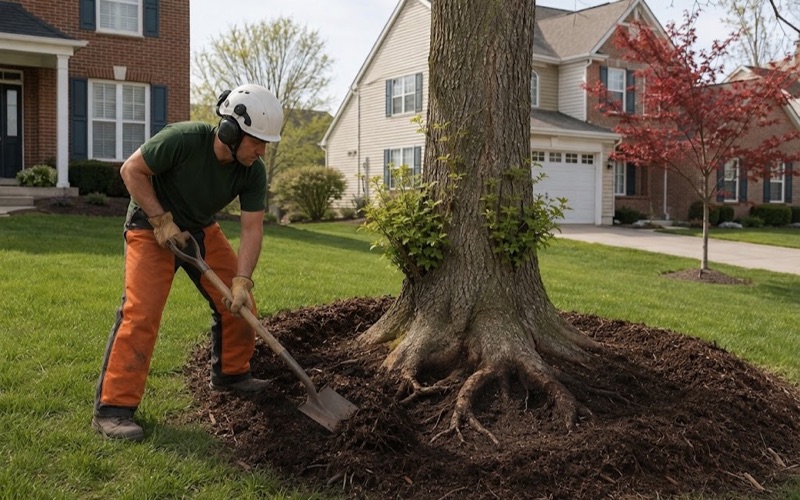
What we look for on a seventy-year-old specimen is structural rather than cosmetic. Co-dominant stems joined with included bark, a conk near the base, dead wood held high in the crown, and a root flare buried under decades of added grade are the findings that move a tree from the prune column to the removal column. Where the flare is the question, we run a root collar excavation with an air spade instead of guessing, because a girdling root and a decay pocket look identical from above the soil line.
The ones we tell you to keep
A cohort reaching age together is not a cohort that all has to come out. Cabling and bracing buys years on a co-dominant union that is sound apart from its geometry, and crown cleaning or a measured crown reduction resolves much of what reads as a hazard tree from the ground. Our pruning is worked to the objectives and cut types the ANSI A300 standard defines, and we do not top trees. When a tree risk assessment says a tree can stay, that is what our report says.
Looking for tree removal closer to Spring Hill? See Spring Hill Tree Removal.
What the city asks before a saw starts
Work on a lot covered by Oak Hill’s tree protection standards begins with a tree removal permit: until and unless one is issued, trees are not to be removed. Those standards sit in Chapter 14, Part 9 of the municipal code, and the Board of Commissioners adopts and administers them from 5548 Franklin Pike. The city incorporated in 1952 and runs its own zoning and land use control, so this is city business, not county business.
A percentage, not a count
The retention standard is written against what was on the site to begin with. A minimum of 54 percent of predevelopment tree canopy cover must be retained and protected, so the question is never simply how many trees are going but how much canopy the parcel keeps. Where satisfying that is clearly impractical, an applicant may appeal for a variance rather than proceeding and arguing afterward.
Eight inches at four and a half feet
The frontage rule is the one that catches homeowners. Trees standing between a building, existing or proposed, and the adjacent right-of-way of a primary or secondary street must be preserved where their diameter at breast height is eight inches or greater, and diameter at breast height is defined as the measurement taken four and one-half feet above existing grade. The trees between the house and the road are the ones the code protects most specifically, and they are also the ones most likely to be shading a roof or hanging over a parked car.
We measure at the defined height and write the number down before anything else happens, since a trunk measured casually at chest height on a sloping yard can read under the threshold when it is not.
Fencing, and paperwork somebody can act on
Where construction is involved, orange plastic barrier fencing is installed and maintained at the limits of the tree preservation areas before work begins, with the city’s review and approval required ahead of the grading permit. We supply written tree condition reports a homeowner can hand to a neighbor, an insurer or a city reviewer, and we put in writing what is included before we start: the stump, the trunk rounds, the grindings and the chips. Tennessee licenses no trade-specific arborist, but Davidson County adopted the state Home Improvement license, so residential work from $3,000 to $24,999 is licensed here and anything at $25,000 and above requires a state contractor license.
Slope, chert and the Radnor Lake impact zone
The city covers 7.845 square miles at an elevation of 581 feet, and yet Radnor Lake State Natural Area, most of which lies inside the city, is an outlier of the Western Highland Rim carrying some of the highest ridges in the Central Basin, above 1,200 feet. That six-hundred-foot range inside one small city is the whole access story. A crew can work a flat frontage in the morning and a Rim ridge in the afternoon, and the soil, the rock depth and the legal regime all change in between.
Where the Planning Commission signs off
Existing vegetation on slopes of fifteen percent or greater may not be removed except as approved by the Planning Commission, natural vegetation is to be preserved to the maximum extent possible, and a tree removal permit on a steep slope cannot issue unless those steep-slope regulations are satisfied. Inside the Radnor Lake Natural Area Impact Zone, which overlays the same ground, clearing is limited to what the driveway, turnaround, house site and a reasonable landscaping area require, and the Planning Commission may require replacement of removed trees up to the caliper inches taken. A parcel can carry both sets of requirements at once, and we plan the work assuming it does until the file says otherwise.
What the ground does to equipment
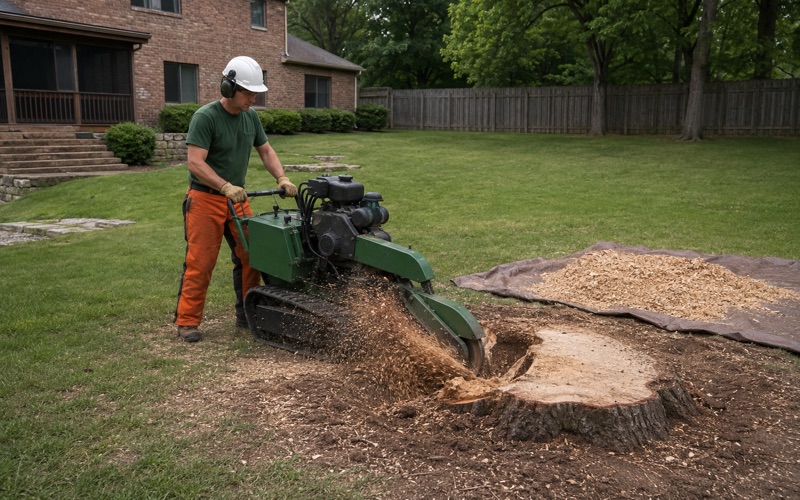
On the steep chert slopes the mapped material is Bodine, somewhat excessively drained and formed in colluvium weathered from cherty limestone, running 35 to 80 percent chert rock fragments through the particle-size control section. Depth to rock is not the constraint there; the volume of loose stone is, both for footing and for what it does to a grinder wheel. Lower down on the basin slopes the material is clayey limestone residuum, and the Talbott series is the shallow case at 20 to 40 inches of solum over limestone, so a tracked stump grinder set for 12 to 16 inches below grade can be in soil on one lot and into weathered rock on the next.
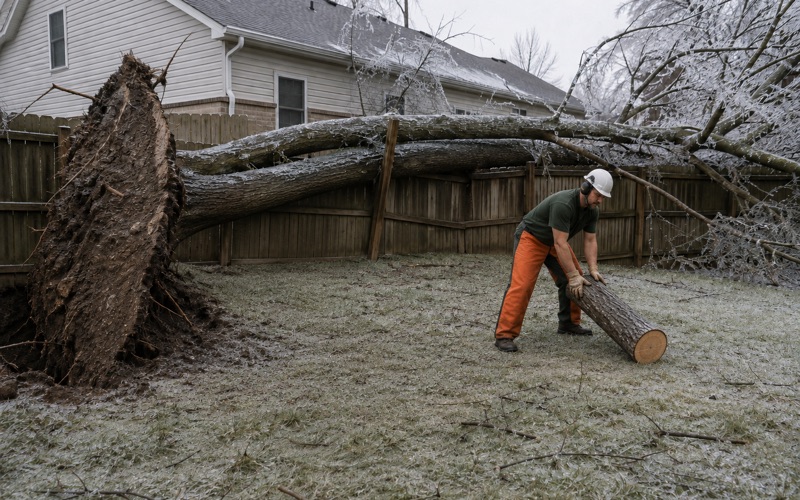
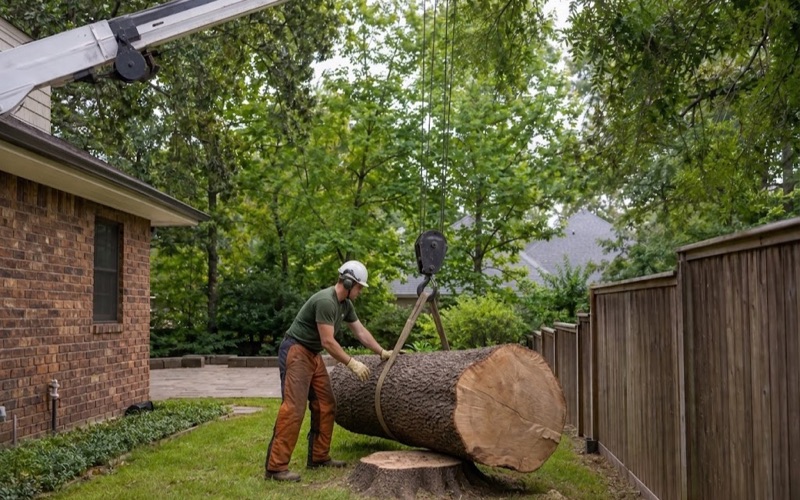
Slow permeability in that clay keeps water in the root zone instead of draining it away. Windthrow here is usually a wide, shallow root plate spread over weathered rock, saturated after a long rain, on a grade, under a mature crown. Our compact tracked equipment fits a thirty-five-inch gate, so a back-yard tree does not automatically become a crane job, and we keep crane and rigging capacity for the mature canopy these older lots carry.
Where the wood goes
Yard waste is banned from trash collection across Davidson County, and the countywide service does not collect brush inside self-incorporated cities, so disposal is settled locally. The city contracts for complimentary monthly collection of typical yard waste, meaning tree limbs and shrubbery pruning with no roots or dirt, plus bagged leaves. That covers trimmings; it does not cover a removal’s worth of wood.
Trees to Trails
The chipped material has a named destination here. Trees to Trails is a partnership among Radnor Lake staff, the City of Oak Hill and Clean Earth: residents set trees along their road frontage for pickup or bring them to Radnor Lake during a January drop-off window, Clean Earth chips them, and the chips are delivered to the natural area as trail mulch. The program has grown beyond holiday trees to take in storm-damaged branches and removed limbs that would otherwise be landfilled.
The park’s stated reasons for mulching are practical: less impact on heavily trafficked paths, less sedimentation runoff, fewer muddy stretches that cause trails to widen, and native plants that do not get trampled. The mulch has reached the Access, South Lake and Valve-House trails and parts of the South Cove and Ganier Ridge trails.
The trees along the line
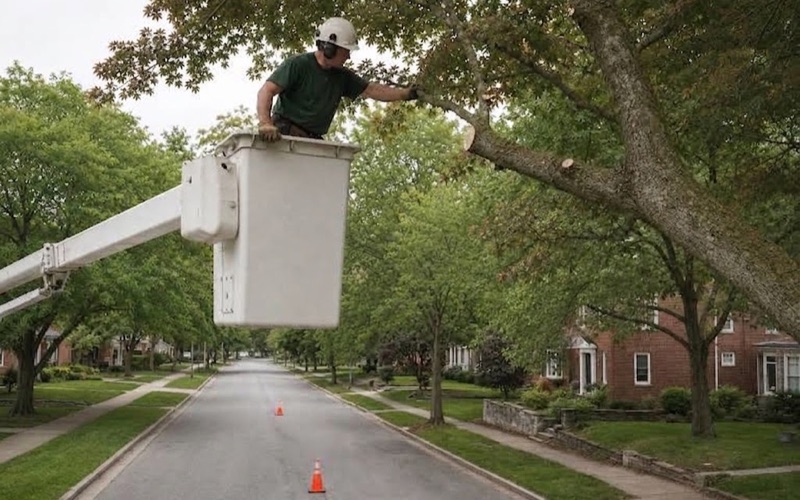
Nashville Electric Service changed its clearance standard after the ice storm of January 24-25, 2026, which laid down a quarter to a half inch of ice across much of the area and left Radnor Lake closed with more than seven miles of trail blocked by downed trees. NES widened the cleared zone from ten feet below the lines to fifteen feet for all species, in a horseshoe pattern, and stopped ground-to-sky trimming, leaving lower vegetation and limbs where it can. Metro Council asked the utility to pause the blanket fifteen-foot rule and NES declined, citing the risk from overgrown trees ahead of severe weather season; NES reported trimming 587 miles of vegetation between July and December 2025, across areas that had gone four years without maintenance.
The practical result is a utility working to a wider profile than the one these trees grew up under. Ice loading rather than wind is the failure mode this terrain gets, and our storm planning is built around that instead of a generic script. If a tree of yours sits inside the clearance envelope, we will tell you what is likely to happen to it and whether what remains is worth keeping.
- 20+ Years in Middle Tennessee
- Free Estimates
- Written Scope Before We Start