Franklin Tree Removal takes on shrub, hedge and brush removal across Franklin, TN, and after more than twenty years here the jobs are familiar: foundation plantings that swallowed the windows, a screening hedge that died out in the middle, and a fence line nobody has touched in a decade. It is the least glamorous work we do and the one that changes how a property looks the fastest.
Most of it is not really a cutting problem. It is a debris problem. A quarter acre of overgrowth produces an astonishing volume of material, and what it costs to make disappear depends on choices made before the crew arrives, which is why our proposal names what is chipped, what is hauled and what stays.
That matters more since disposal in this county changed. The Williamson County Landfill on Pinewood Road charges brush by the ton, its resident free-tonnage allowance was suspended beginning May 4, 2026, and convenience center brush intake was capped at three feet in length on the same date. A homeowner who planned to haul their own has fewer options than they had a year ago.
Shrubs and Hedges
Overgrown Foundation Plantings
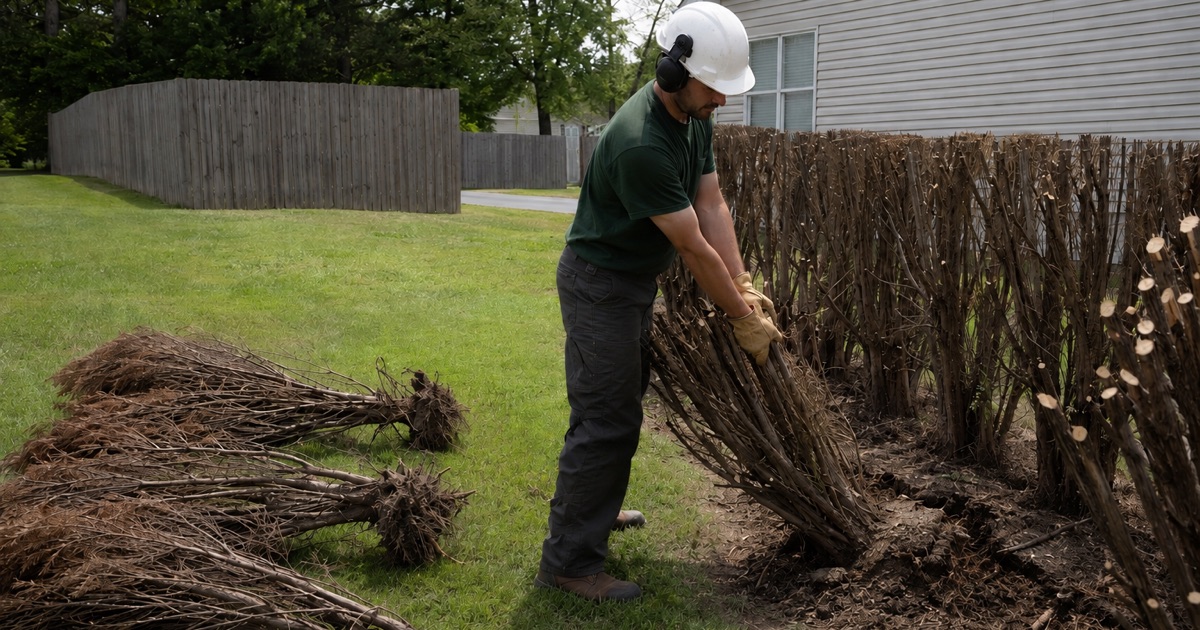
Shrubs planted against a house are usually removed for one of two reasons: they have grown into the siding and the gutters, or they have gone woody and bare at the base and no amount of pruning brings them back. Taking them out means working close to the structure, the meter, the downspouts and whatever irrigation is buried alongside, so it is careful work rather than fast work.
Failed Screening Hedges
A privacy hedge that has died out in sections rarely recovers, and Leyland cypress in particular does not regenerate from cuts made back into old wood. The practical decision is whether to remove the whole run and start again or to take out the failed sections and live with an uneven line. We will give you an honest read on which one the planting can support.
Shrub Stumps and Root Balls
Most ornamental shrubs come out root ball and all with the right equipment, which leaves a hole to backfill rather than a stump to grind. Long-established plantings, and anything that has been cut back repeatedly over the years, can have a root mass out of proportion to what shows above ground. That is worth knowing before the bed is redesigned around it.
Brush, Thickets and Fence Lines
Volunteer Growth Along a Boundary
An untouched fence line is rarely just brush. It is volunteer eastern redcedar, hackberry and whatever the birds dropped, grown up through the wire, with vines that have to be cut off the posts before anything can be pulled. We clear to the line on your side, and where the boundary is unclear we recommend settling that before the saws start rather than afterward.
Invasive Thickets That Resprout
Some of what fills a neglected edge comes back harder for being cut. Tree of heaven, privet and Callery pear all resprout aggressively from cut stems and roots, and clearing them without treating the stumps buys one clean season. Where those dominate, we handle the stumps as part of the job so the work is not repeated every spring.
Creek Banks and Drainage Ways
Overgrowth along a drainage way or a creek bank is a different problem, because the roots holding the surface together are also the roots you are being asked to remove. We stage that work, keep cover where it is genuinely doing something, and mulch in place where the material can serve as erosion protection rather than being hauled away.
What Happens to the Debris
Chipping On Site
A wood chipper is the cheapest thing that can happen to brush, since it reduces the volume dramatically and turns a haul into a load. Chips can go back onto beds and paths on the property, which costs nothing and is often the best answer for a rural or wooded lot. Where you would rather they left, that is a truckload rather than a fleet.
Hauling and Disposal Costs
Anything that will not chip has to be handled. The county landfill sits at 5750 Pinewood Road with a Franklin address, open Monday to Friday from 7:00 a.m. to 4:00 p.m. with check-in closing at 3:15 p.m., and it charges brush and general waste at separate per-ton rates. Commercial loads have always been charged, so what changed recently affects homeowners hauling their own rather than contractor pricing.
The City’s Right-of-Way Collection
For material a homeowner cuts, Franklin does collect brush placed in the right-of-way under specific stacking rules, and after a major storm it suspends its usual excess-brush policy. That is a useful route for a weekend of hand pruning. It is not a route for a hedge run or a cleared fence line, which is why crew chipping and hauling is the practical answer above a certain volume.
Access and Scheduling
Getting Equipment to the Work
The distance between the brush and a truck decides most of the cost on these jobs. Our compact tracked machines fit through a thirty-five-inch gate, which keeps a back yard from becoming a wheelbarrow operation, and we check the route in when we quote. Where nothing can reach, the work is done by hand and priced honestly for what that takes.
- 20+ Years in Middle Tennessee
- Free Estimates
- Written Scope Before We Start