Franklin Tree Removal has handled tree removal in Smyrna and across Middle Tennessee for more than twenty years, working both the Nashville Basin and the Western Highland Rim sides of this metro. That range matters more than it sounds like it should, because the ground under a tree decides how the tree fails and how far a grinder gets before it stops.
Most of what a homeowner needs settled before a removal turns out to be procedural rather than technical. Who signs off on the work, what the electric cooperative already has the right to cut, and what is left in the yard when the truck pulls out. We put the answer to that last one in writing first, so the stump, the trunk rounds, the grindings and the chips are accounted for in the estimate instead of negotiated afterward.
We also say so when a tree does not need to come down. Cabling and bracing or a structural pruning cycle will carry a tree that a sales pitch would have taken to the ground, and a written condition report gives you something to hand a neighbor, an insurer or a plan reviewer. Estimates are free, and the answer on whether a job is worth an insurance claim is a straight one.
The town where Middle Tennessee’s storms are officially measured
When a forecast or a news report quotes what a winter storm did to Rutherford County, the numbers were usually recorded inside this town. The National Weather Service office in Nashville logged the county’s observations for the January 24 to 28, 2026 storm at the Smyrna-Rutherford County Airport: 2.1 inches of snow, 0.3 inches of freezing rain, and temperatures as low as minus 4 degrees. Those are observations from one event rather than climatological normals, and we treat them that way when we plan for the next one.
The town sits in National Weather Service public forecast zone TNZ062, Rutherford, served by the Nashville forecast office and radar station KOHX, and that same zone is its fire weather zone. Watching one zone rather than a regional average is how we decide whether a scheduled takedown goes ahead on a given morning or gets moved.
Ice loading is documented here, not a figure of speech
The USDA Forest Service biophysical setting model for the limestone glade and woodland system of this basin names ice storms, along with periodic drought, fire and historic grazing, among the disturbances that hold woody growth back. That puts ice in the structural history of the trees themselves rather than in a regional generality. The same model describes thin soils that dry through summer and autumn and turn saturated through winter and spring, which lands the wettest ground and the ice season in the same months.
What the cooperative saw in January
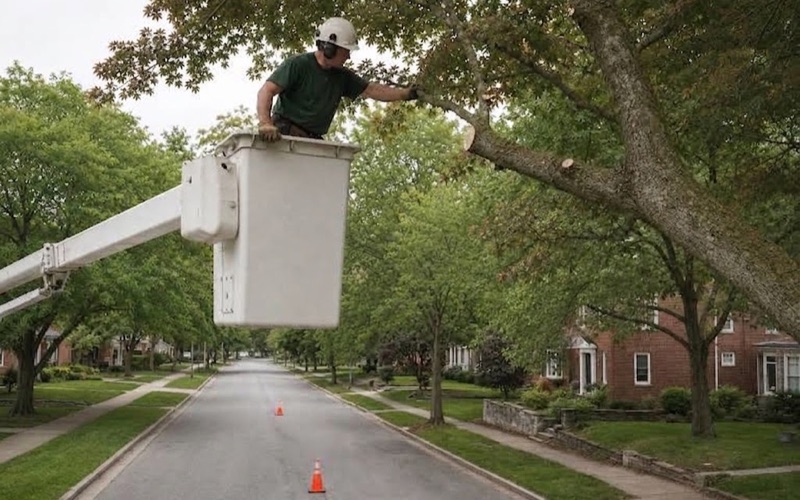
Middle Tennessee Electric’s president and chief executive, Chris Jones, described the January 2026 ice storm as one of the most significant challenges in the cooperative’s ninety-year history, and described crews finishing a restoration and then watching more trees fall onto the same lines as they drove away. MTE’s cleared right of way is 40 feet wide, 20 feet on each side of the line, and its own crews cut back or eventually remove what grows into it. Before we quote a tree near a line we establish which side of that boundary it stands on, because one side is our work and the other is theirs.
Looking for tree removal closer to Columbia? See Tree Removal in Columbia.
Airport approach surfaces and the trees under them
The airport began as Sewart Air Force Base, established in 1941 and scheduled for closing in 1971, with the property later developed into what is now the Smyrna/Rutherford County Airport Authority. The zoning that came with it is still on the books. Article X of the town’s zoning ordinance is a height zoning ordinance for the airport, and sections 10.030 and 10.040 impose height limitations and use restrictions on land beneath the approach surfaces.
On a parcel under one of those surfaces that is a ceiling on how tall anything is allowed to stand, a mature tree included, and it applies independently of any landscape requirement. It is the one local rule capable of turning a healthy tree into a removal rather than a pruning job, which is why we check it before quoting anything tall near the field.
Living under a ceiling
Where a tree is climbing toward a height limit, the honest options narrow quickly. Crown reduction worked to proper cut types buys time on some species and does very little on others. Topping is not an answer at all: the ordinance defines it as cutting limbs back to stubs larger than three inches in diameter within the crown to a degree that removes the normal canopy, and it is not permitted as maintenance of trees required under the landscape section. We would not do it in any case, because our pruning follows the objectives and cut types the ANSI A300 standard defines.
When the ceiling is real and the tree is going to keep growing into it, removal paired with a replacement species that matures shorter is the durable answer rather than a pruning subscription that never ends.
Removing a tree here without a town permit
The Zoning Ordinance of Smyrna, Tennessee is dated October 14, 1986 and has been amended since, and its table of contents carries no tree preservation article, no tree removal article and no tree permit section. An absence like that is easy to distrust, so it is worth naming what sits beside it. Section 3.150, the Landscape Treatment Regulations, runs six pages of detailed tree rules covering minimum crown spread, clear trunk height, caliper, root barriers, species exclusions, replacement periods and topping.
The ordinance is plainly not silent about trees. It regulates them in specifics and still imposes no removal permit and no trunk-size cutoff for taking down an existing tree on private property. Section 3.150(B) confines that whole section to new site development and changes of use, which is the line most homeowners are actually asking about: a landscape plan and its performance security belong to a development project, not to a family taking a failing tree out of a back yard.
Most of the housing here is owner-occupied, at 57.4 percent by the American Community Survey’s 2024 five-year estimates, with 10,272 owner-occupied one-unit detached homes counted. The practical effect is that the person deciding a tree comes down is usually the person living under it, with no landlord or association in the middle of the conversation.
The credit ladder that rewards keeping a tree
On development sites the ordinance runs the opposite direction from a removal rule. Section 3.150(D) lets an existing healthy tree stand in for several of the new trees a site would otherwise have to plant, on a caliper scale: a tree of 6 to 12 inch caliper counts as two required trees, one of 12 to 24 inch caliper counts as three, and one of 24 inch caliper or greater counts as four. Each tier also sets a minimum landscaped area around the trunk, 150 at the first tier, 250 at the second and 300 at the third, measured in square footage of planted ground.
Two things about that scale get misread constantly. It is measured as caliper, not as diameter at breast height, and it is a preservation credit rather than a permission rule, since it pays a builder for keeping a mature tree and says nothing at all about whether one may come down. We flag the trees that qualify before a site plan is finalized, because a preserved tree earning four planting slots is worth defending through construction with a fenced tree protection zone.
The license that actually applies
Tennessee issues no trade-specific tree-care or arborist license, so the credential worth asking about is a general one. The state requires a contractor license for work of 25,000 dollars or more, and a Home Improvement Contractor license for residential work from 3,000 to 24,999 dollars in the nine counties that adopted the law, Rutherford among them, with 10,000 dollars of financial responsibility posted and landscaping written into the statutory definition of home improvement. Before a grinder touches the ground we also file the notice of intent to excavate with Tennessee 811, because stump grinding and root excavation count as digging under the statute whatever a stump looks like from the street.
Thin soil over limestone and how deep a grinder gets
Smyrna sits in the Inner Nashville Basin, EPA Level IV ecoregion 71i, underlain by flat-lying Ordovician limestone; the name carried unchanged from the 1998 delineation into the 2007 revision published by the Tennessee Department of Environment and Conservation. The soils on top of that rock are shallow. The Barfield series, whose type location is in Rutherford County, runs 8 to 20 inches to limestone bedrock, the Gladeville series about 3 to 12 inches, and the moderately deep Talbott series 20 to 40 inches.
What that does to a stump
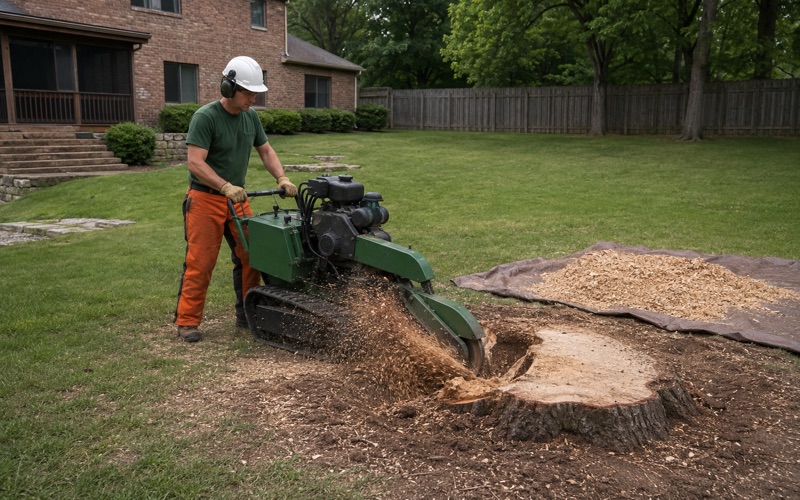
A tracked stump grinder rated to cut 12 to 16 inches below grade will find bedrock before it finds the bottom of the root plate on a Barfield or Gladeville profile. Grind depth is limited by rock rather than by the machine, which is why we will not promise a below-grade number sight unseen on a yard here. What we will do is tell you on site what the rock is likely to allow, and what that leaves you for replanting in the same hole.
Why whole trees come over instead of breaking
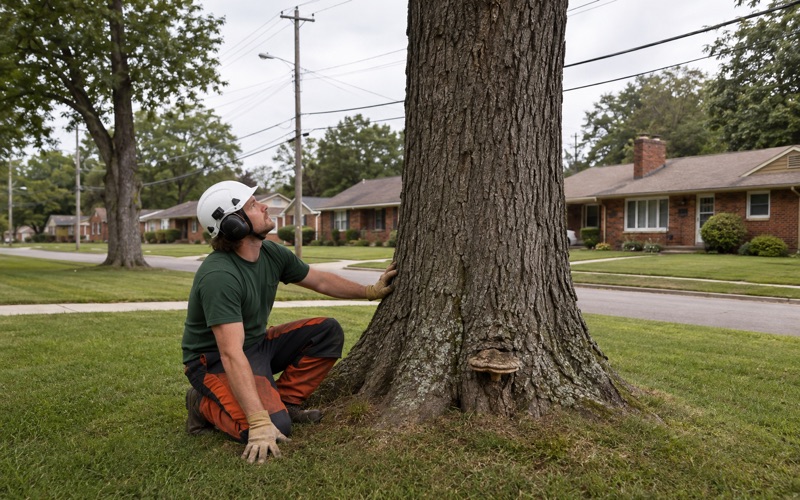
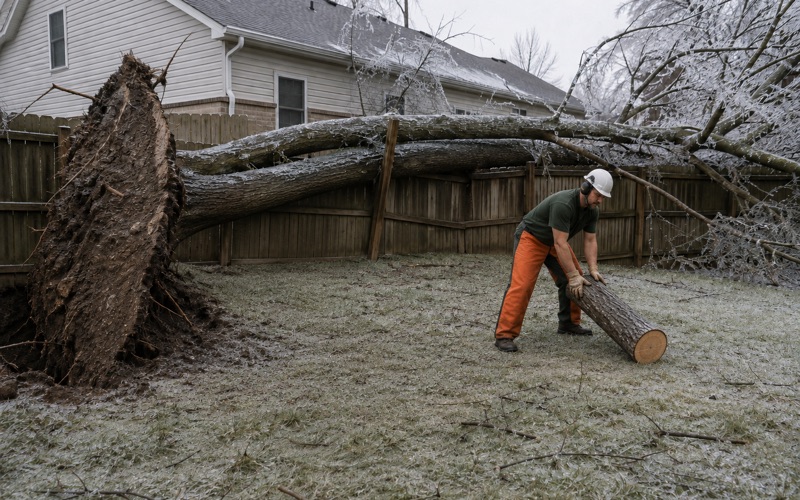
Where rooting depth is capped by rock, a mature tree spreads a wide, thin root plate instead of a deep one. In saturated ground that produces windthrow, the whole tree levering out with its plate attached, rather than a trunk failure partway up. It is the first failure mode we look for, so the root flare and the soil around it get inspected rather than only the crown. A root collar excavation with an air spade shows decay, girdling roots or a conk at the flare that a scan from the driveway misses entirely.
Putting something back
Replanting near a curb, sidewalk or public line runs into a specific local rule. Species whose roots are known to damage public roadways or other public works may not be planted closer than 15 feet to them unless the root system is fully contained in a barrier at least five feet deep built of four-inch-thick reinforced concrete. That spec is stiff enough that on most lots the practical answer is to move the tree, not to build the box. The natural woody cover of this basin, post oak and chinkapin oak and eastern redcedar with redbud, winged elm and blue ash alongside them, is where a replanting plan here can start.
- 20+ Years in Middle Tennessee
- Free Estimates
- Written Scope Before We Start