Franklin Tree Removal has been handling tree removal in Spring Hill for more than twenty years, and the first thing our estimator settles here is not the tree at all — it is which county your driveway sits in. A Spring Hill address can be a Maury County address or a Williamson County address, and that one detail moves the disposal fee, the forecast zone your storm warning was issued under, and sometimes the utility that owns the wire over your side yard.
So we quote the whole job on paper before a saw comes out: the stump, the trunk rounds, the grindings and the chips, and who is moving each of them off your lot. In a city that straddles a county line, that written scope is not paperwork for its own sake — what it costs to get wood off your property depends on where the truck goes with it afterward.
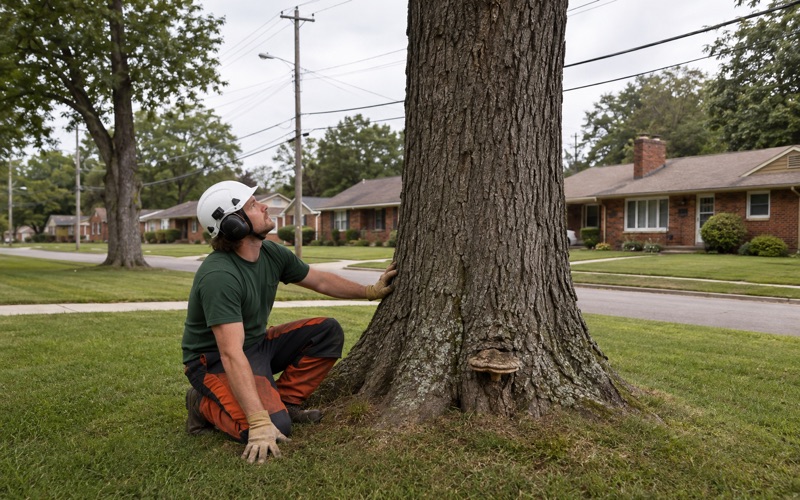
Every removal we bid is looked at first by an ISA Certified Arborist, and if the tree can be cabled, braced or pruned instead of taken down, we will tell you that and quote it that way. Estimates are free, and you get a straight answer on whether the job is worth an insurance claim.
One city, two counties, and why the answer changes with your address
Spring Hill is an incorporated city run by a Board of Mayor and Aldermen, and its limits lie in Maury and Williamson counties at once. One set of municipal rules covers all 29.14 square miles of it, while the county rules underneath change partway across town. We write down which county a property falls in before we price the haul-off, because that line decides where our chip truck is allowed to tip.
The demographic picture is simpler than the map. The Census Bureau treats the place as a single geography, so the housing tables are not split by county: of 20,536 housing units, 15,604 are single-family detached, and 7,801 of the city’s homes went up between 2010 and 2019. Most of the tree work here is therefore on relatively young lots with relatively young canopy, punctuated by the older parcels that were here before the subdivisions.
Two forecast zones over one town
A point in the Maury County part of the city returns National Weather Service forecast zone TNZ060, Maury. A point in the Williamson County part returns TNZ059, Williamson. Both are issued out of the Nashville forecast office, so the meteorology is shared, but the warning is not — a winter storm warning or a wind advisory can cover one part of Spring Hill and stop at the county line running through it. During an event we watch both zones rather than the one that happens to match a mailing address.
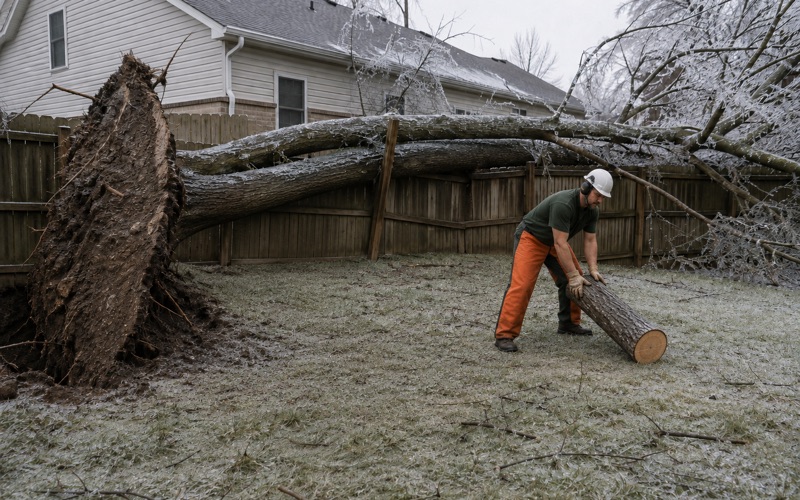
Ice is the load case that matters on this ground, not tropical wind. The Nashville forecast office recorded a major winter storm on January 26, 2026 that brought ice accumulations of half an inch or more and crippled the Nashville metropolitan area. Our storm response is planned around that kind of loading and around straight-line wind, because a limb failing under accumulated ice is a different rigging problem than a stem snapped by gusts.
Looking for tree removal closer to Fairview? See Tree Removal in Fairview.
Three electric utilities and whose clearance rules apply to your tree
Three different electric providers serve parts of this city — Middle Tennessee Electric, Columbia Power and Water Systems, and Duck River Electric Membership Corporation — and the city’s own FAQ tells residents to check the electric bill to find out which one is theirs. We ask for that answer before bidding any tree near a conductor, because the utility that owns the line also owns the clearance standard we are working alongside.
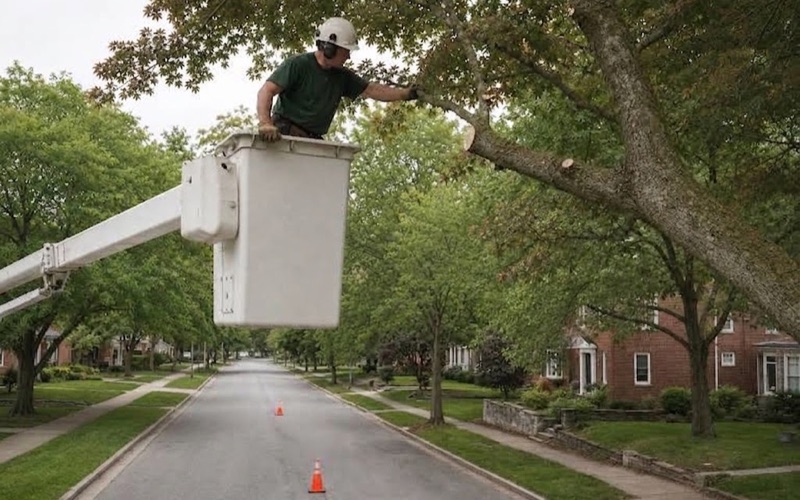
Middle Tennessee Electric maintains a 40-foot right of way, 20 feet on each side of a power line, and its vegetation management crews cut back or remove trees inside it. That is worth knowing for two reasons: it tells you which part of a tree the utility is likely to handle on its own, and it tells you where our work begins. Right-of-way clearance on an energized primary is line-clearance work; the yard tree leaning toward it is ours.
What we do with the rest of the tree
Everything outside that corridor is an ordinary removal or an ordinary pruning job, worked to the ANSI Z133 safety requirements and, when we are pruning, to the cut types and objectives the ANSI A300 standard defines. Crown cleaning, crown raising and crown reduction are all legitimate answers to a canopy crowding a service drop. Topping is not one of them, and we do not do it — where a co-dominant stem with included bark is the real defect, cabling and bracing usually buys the tree years instead.
Where the wood goes, and what the city expects from a contractor
The City of Spring Hill sanitation policy, effective November 1, 2022, states plainly that all contractors are required to dispose of their own debris, and it names tree limbs and other yard clippings among the debris it means. Curbside collection is for brush and limbs cut by the homeowner, which must be less than 10 feet long and at the curb by 6:00 a.m. on Tuesday, with pickup running Tuesday through Friday. Wood from a contracted removal never becomes a curb pile: that is our truck, our fuel and our tipping fee, and the estimate says so.
Where it goes depends on which county the address is in. The Maury County transfer station at 1233 Lawson White Drive in Columbia charges $78.00 per ton with a $25.00 minimum, and a business must submit a W-9, a certificate of insurance and a business license for approval before it may tip there at all. The Williamson County Landfill at 5750 Pinewood Road in Franklin takes commercial brush, clean wood waste and chips at $40.00 per ton, and the county has announced that beginning May 4, 2026 there is no free disposal there and all incoming loads are charged regular tonnage fees, with free disposal not resuming until January 2, 2027.
Private streets change who hauls anything
Properties on streets platted as private receive no city brush or bulky collection at all; those residents get a $2.35 monthly credit on the sanitation bill instead. Across a city built largely of newer subdivisions, whether the street in front of the house was platted public or private is the difference between a homeowner-cut limb getting collected and it sitting where it landed. We raise that on the walk-through so nobody is left with a pile the city will not take.
Ordinance 24-05 and the hours a saw can run
Ordinance 24-05, adopted May 20, 2024, repealed and replaced the unnecessary noise standard at Title 11, Article 402, Section 10 of the municipal code. Its hours reach only work that requires a permit issued by the City of Spring Hill, but where they reach, they cover all work on the project: Monday through Friday 7:00 a.m. to 6:00 p.m., extended to 8:00 p.m. from June 1 to August 30, and Saturday 9:00 a.m. to 6:00 p.m. No permit-requiring construction activity happens on Sundays or city holidays, and none on New Year’s Day, Memorial Day, Independence Day, Labor Day, Thanksgiving Day or Christmas Day.
The ordinance defines construction activity broadly enough to matter to us: it reaches site preparation and landscaping work including trimming, and the operation of power shovels and similar construction-type equipment. A clearing job tied to a permitted project is inside those hours whether or not anyone calls it construction. Reading the ordinance before scheduling the crew is a habit we brought from Franklin, Brentwood, Forest Hills and Oak Hill, which each answer the permit question their own way.
What licensing actually applies
Tennessee has no trade-specific tree care or arborist license, and the county-option Home Improvement license has been adopted in nine counties — neither Maury nor Williamson is among them. The state contractor license applies at $25,000 or more of materials and labor. That leaves a homeowner to check insurance, references and a written scope, which is why we will hand over a written tree condition report on request — the kind you can give a neighbor, an insurer or a city reviewer without translating it first.
Basin soils, grinding depth and why trees here fail at the plate
The city center falls inside EPA Level IV ecoregion 71h, the Outer Nashville Basin, within Level III ecoregion 71, the Interior Plateau. That is a statement about what is under the lawn. Soil series common to the Outer Nashville Basin include Dellrose, Mimosa, Bodine, Stiversville, Hampshire, Armour, Maury, Barfield, Hawthorne and Sulphura, and two of them set the working depth: Mimosa, whose solum runs 40 to 60 inches with bedrock at about 55 inches in the typical pedon, and Talbott, whose solum and depth to bedrock together run only 20 to 40 inches.
What that means for the stump
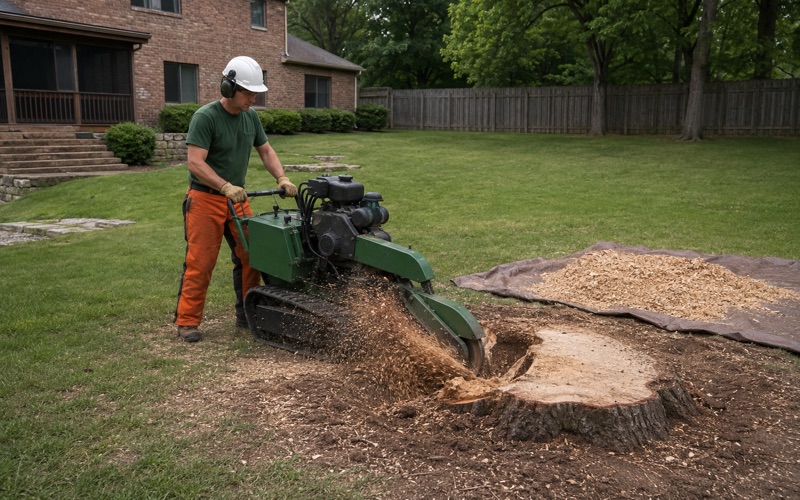
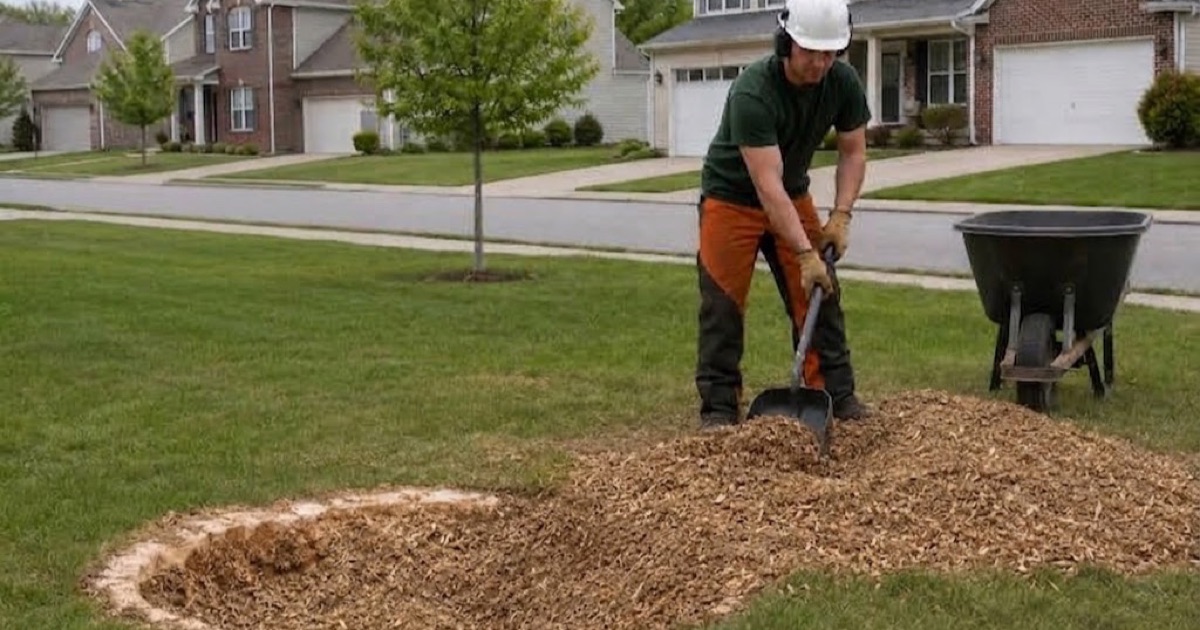
A stump grinder rated to take 12 to 16 inches below grade is working in soil on a Mimosa profile. Ask the same wheel to chase a large root plate on a Talbott profile and it is working toward rock, since hard limestone can sit 20 to 40 inches below grade there. We say which of the two we expect in the bid rather than finding out with the machine already on site, and the grindings are written into the scope as well — hauled off or left to backfill the hole, your call.
Windthrow, redcedar, and getting into a back yard
Shallow residuum over limestone is also the failure mechanism here. A tree that cannot root deeper than the rock spreads a wide, shallow plate instead, and in saturated ground under wind or an ice load the whole plate lifts rather than the stem breaking — which is why a leaning tree with a heaving root flare gets a same-week look from us. Eastern redcedar is the species that colonizes thin residuum over limestone and takes over an unmown pasture, so a lot-clearing job on this ground is usually cedar rather than the white oak, shagbark hickory and black walnut of the older wooded slopes.
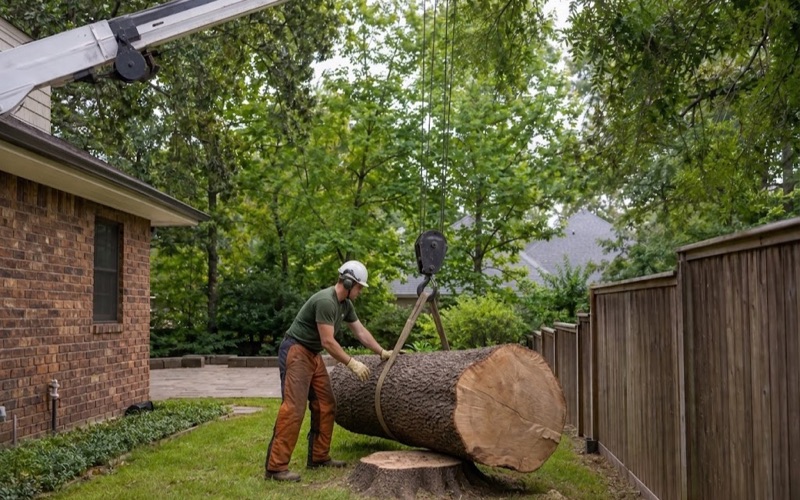
Reaching the tree is the other half of the estimate. Our compact tracked equipment fits through a thirty-five-inch gate, so a back-yard removal on a newer lot does not automatically become a crane job, and we keep crane and rigging capacity for the mature canopy on the older parcels where it genuinely is one.
- 20+ Years in Middle Tennessee
- Free Estimates
- Written Scope Before We Start