
Franklin Tree Removal has been grinding stumps across Franklin, TN for more than twenty years, serving surrounding cities including Brentwood, Thompson’s Station, Nolensville, Forest Hills and Oak Hill. We grind stumps from trees we felled and stumps that have been sitting in a lawn since long before we arrived, and we grind them to a depth we have checked rather than a depth we assumed.
That last point is the whole difference in this county. Williamson County’s own soil-mapping regulation records depth to rock in inches by soil series, with worked examples in exactly that form: a Talbott series at 20 to 22 inches to rock on gentle slopes, and Rockland defined as ground where 50 to 90 percent of the surface is exposed rock. A machine rated to cut 12 to 16 inches below grade is close to its limit on the first and sitting on stone outright on the second.
So we probe before we price. Depth to rock here is a per-parcel number rather than a citywide one, and it can change across a single back yard. Quoting a standard depth and discovering limestone halfway through is how a stump job turns into an awkward conversation in a driveway, and it is entirely avoidable with a probe rod and ten minutes.
What Stump Grinding Removes, and What It Leaves
Grinding Against Excavating the Root Ball
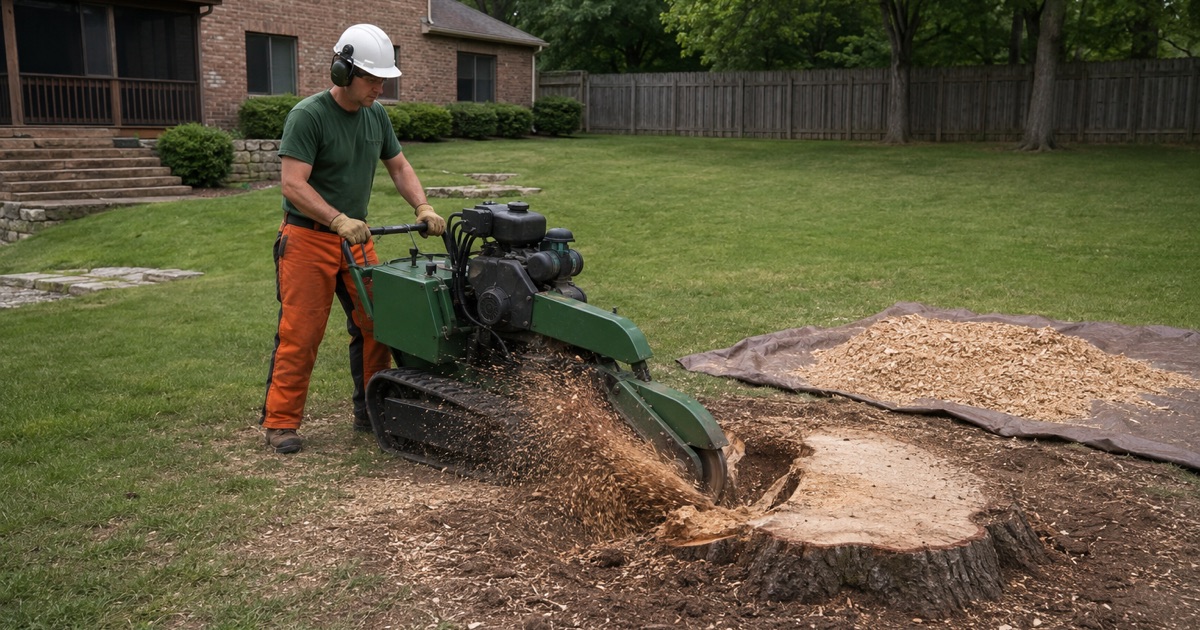
A tracked stump grinder cuts the stump and the major surface roots into chips in place, leaving a hole filled with grindings and almost no disturbance around it. Excavation drags the entire root ball out and leaves a crater, torn roots running into whatever is adjacent, and a repair problem in a finished lawn. For a residential stump, grinding is the answer nearly every time; excavation belongs to construction, where the ground itself has to be cleared to depth.
How Deep the Machine Actually Cuts
Twelve to sixteen inches below grade is the working range, and that range is set by the geometry of the cutting wheel rather than by effort. It is deep enough for turf, for shrubs and perennials, and for a patio or walk carrying no structural load. It is not deep enough to remove every root a mature tree ever grew, and any contractor promising that on a hardwood is describing a different machine.
Surface Roots and the Second Pass
The visible stump is usually the smaller half of the problem. Major roots radiating out under the turf are what catch a mower deck and telegraph through new sod, so we chase them out from the stump rather than stopping at the collar. Where a root runs under a walk or against a foundation we cut it back to a clean point instead of levering it up and taking the paving with it.
Grinding Over Limestone: The Local Complication
Depth to Rock Is a Per-Parcel Number
The county regulation gives depth to rock by soil series, and the useful consequence is that two lots on the same street can behave completely differently. We probe the stump position itself, not the general area, because the number that matters is under the wheel. When the probe says a surface ledge caps the depth, you hear it before the proposal is written rather than after the grinding stops.
Pinnacles, Troughs and Floaters
The county names five common subsurface rock scenarios and they are not academic here. Tabular rock is typical of glade areas, broad and flat over large areas, while undulating rock has deep and shallow spots. Pinnacle and trough puts rock pinnacles beside troughs three feet or more deep, following the joint pattern in the bedrock. Floaters are random buried blocks, and stair-step or ledge rock is the pattern most typical of hillsides.
Weathered Rock That Reads as Solid
The same regulation separates true rock, meaning a lithic contact and unweathered bedrock, from restrictive horizons that are not rock at all: Cr horizons, paralithic contact, weathered rock, saprolite, fragipans and a seasonal water table. It notes that the Hermitage Formation in this area is sometimes weathered deeply enough that its bedding planes show in the Cr horizon. A grinder will chew through a weathered Cr layer a probe read as refusal, and it will stop dead on a floater the probe never touched.
Grindings, Backfill and What Goes in the Hole
Where the Grindings Go
Grinding a stump produces noticeably more material than the hole it came from, because the chips are loose where the wood was solid. Raking them back and crowning the spot is the default, and the mound settles over a season as they break down. It is the cheapest finish and it is the right one whenever the area is going back to lawn or mulch bed.
Backfilling for Turf, Planting or Paving
If you want seed or sod straight away, or a bed you can plant into this year, the grindings have to come out and topsoil has to go in. Wood chips tie up nitrogen as they decompose, which is why grass sown directly into them comes in thin and yellow. Hauling and backfill is written as its own line on the proposal so the choice is yours rather than a surprise.
Replanting in the Same Spot
Putting a replacement tree exactly where the last one stood is the request we most often talk people out of. The ground is full of decaying wood, the old root plate is still in the profile, and the spot may be the reason the previous tree struggled. Excavating properly and shifting the planting hole a few feet gives the new tree a far better start, and we will say so before the hole is dug.
Residential Yards, Commercial Sites and Acreage
Back-Yard Stumps and Gate Access
Our compact tracked machines pass through a thirty-five-inch side gate and travel on their own tracks, which is what keeps a back-yard stump from becoming a fence-panel removal. We check the route in when we quote, note where protection is needed over a walk or a septic field, and confirm the gate width rather than assuming a standard one.
Commercial Lots, Islands and Right-of-Way Stumps
Parking islands, entrance plantings and right-of-way clearance stumps come with constraints a back yard does not: traffic control, curb protection, irrigation heads and a window when the lot has to be usable again. We schedule those around the property’s own hours and stage the work so that a row of islands is ground, cleaned and reopened in sequence instead of all being torn up at once.
Multiple Stumps and Old Clearing Work
On acreage the stumps are often decades old, and the ground around them tells you why the county warns about mixed soil areas: land cleared with a bulldozer leaves pushed-up root balls and back-filled pits, and several parts of this county were phosphate mined into the 1980s. Buried wood, rubble and re-worked ground all change what a grinder meets, so we price acreage stump work after walking it rather than by the count.
- 20+ Years in Middle Tennessee
- Free Estimates
- Written Scope Before We Start