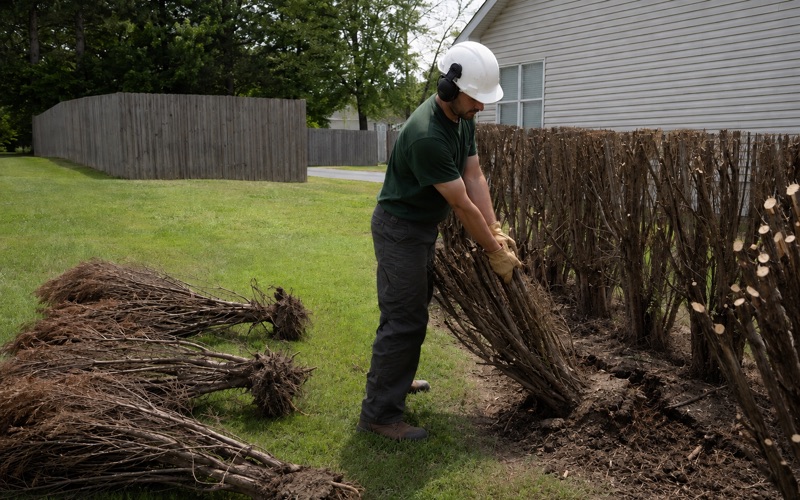
Franklin Tree Removal has spent more than twenty years on tree removal in White Bluff and the rest of Middle Tennessee, working both the Nashville Basin side of this metro and the Western Highland Rim side that this town sits on. Those are two different jobs. A crew that only knows one of them will read the other one wrong.
What we bring to a property here is the habit of reading the ground and the town’s own written standards before the saw comes out. Every quote we write says plainly what is included and what is not: the stump, the trunk rounds, the grindings and the chips. Estimates are free, and if a tree can be cabled, braced or pruned instead of taken down, we will tell you that before you have paid us anything.
We also write tree condition reports you can hand to a neighbor, an insurer or a town reviewer, and we will give you a straight answer on whether a job is worth an insurance claim. The sections below cover what actually changes about this work on this ground.
Tennessee’s state soil, and the pan that decides how a tree fails
The soil under most of this town is the Dickson series, and it is not an obscure one. It is the official state soil of Tennessee, established in Dickson County in 1923 and first mapped in the Soil Survey of Dickson County published in 1926. The Tennessee soil survey staff selected it for the sheer acreage of it mapped across the state, so the soil named for this county is the reference soil for all of Tennessee.
What matters on a job site is the fragipan. That is a firm, brittle layer sitting 18 to 36 inches below the surface, with moderate permeability above it and slow to very slow permeability through it. Depth to bedrock here is greater than five feet, so the layer that stops a root is a pan rather than rock.
When the plate lifts
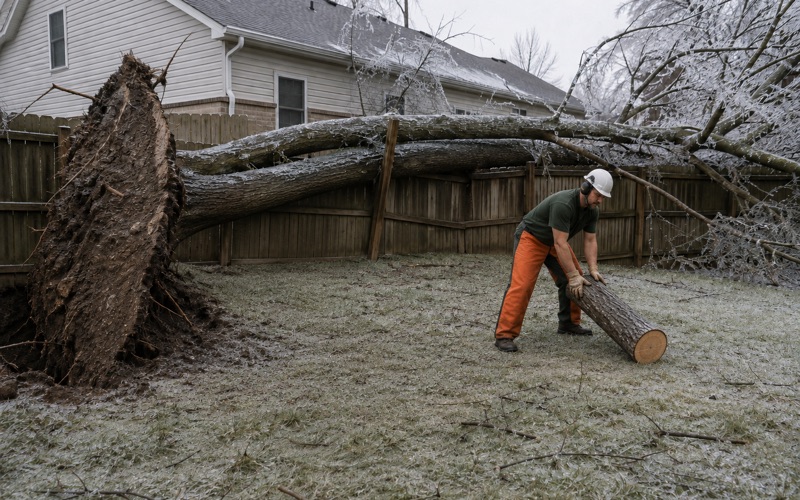
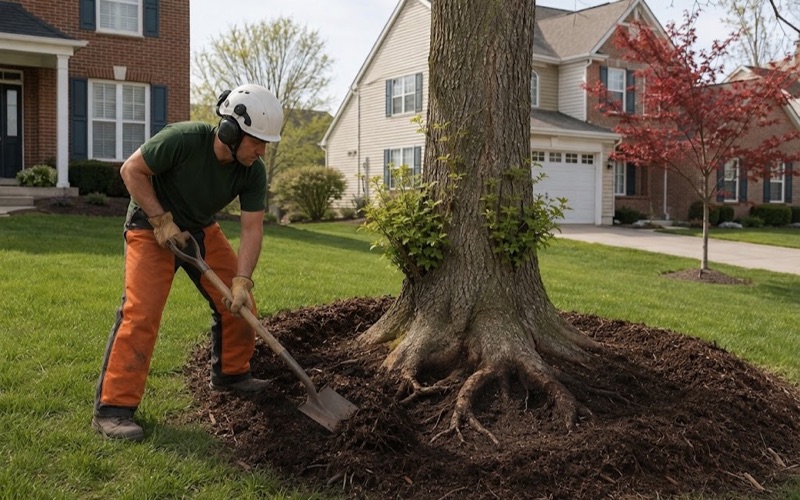
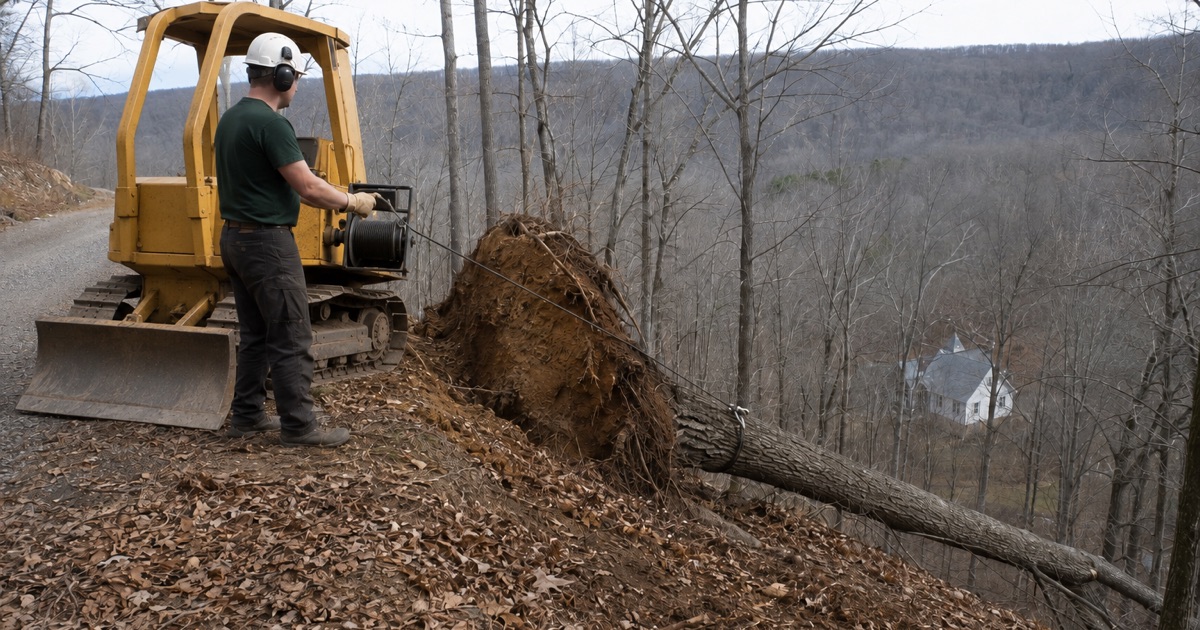
A tree that cannot root past that pan does not build depth. It builds a wide, shallow root plate instead, and in a wet winter the pan perches water above itself, so the plate sits in saturated ground. Load that with ice or a hard gust and the plate lifts: the tree tips whole rather than snapping partway up the stem.
Whole-tree windthrow is a different problem from a broken stem, and it is the one we plan around here. The root flare comes up with the tree and takes the walk, the water line or the fence with it, and the crater left behind is part of the cleanup rather than an afterthought. Our storm work is built around the ice loading and straight-line wind this region actually gets, not a generic hurricane script; the January 2026 winter storm put half an inch or more of ice across Middle Tennessee.
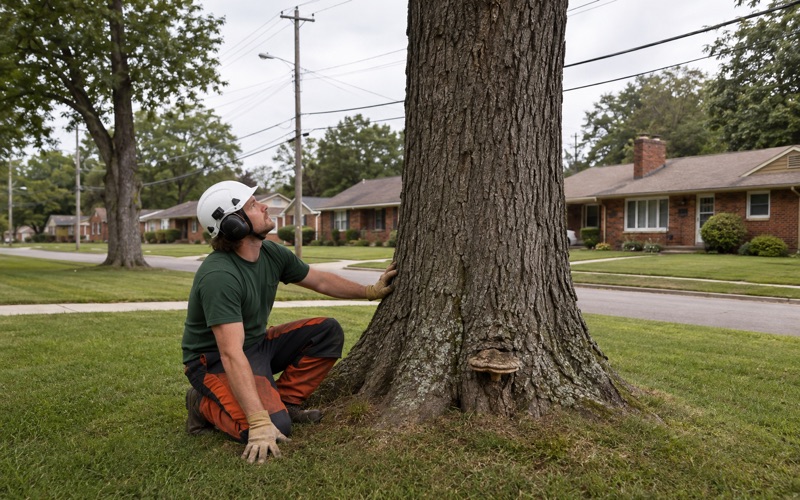
On a tree that is still standing, that same mechanism is what a tree risk assessment weighs. A fresh lean, a heaving root plate, co-dominant stems with included bark, a conk at the base: we measure diameter at breast height, look at the root collar, and tell you which of those is urgent and which is a watch item.
Chert, not bedrock, is what the grinder meets
Bedrock is rarely the obstacle on this ground. Chert is. On the cherty Bodine soils that occupy the steeper slopes around the town, rock fragments run 20 to 85 percent of any given horizon and average 35 to 80 percent of the particle-size control section, mostly chert gravel, cobbles and stones, on slopes anywhere from 5 to 70 percent.
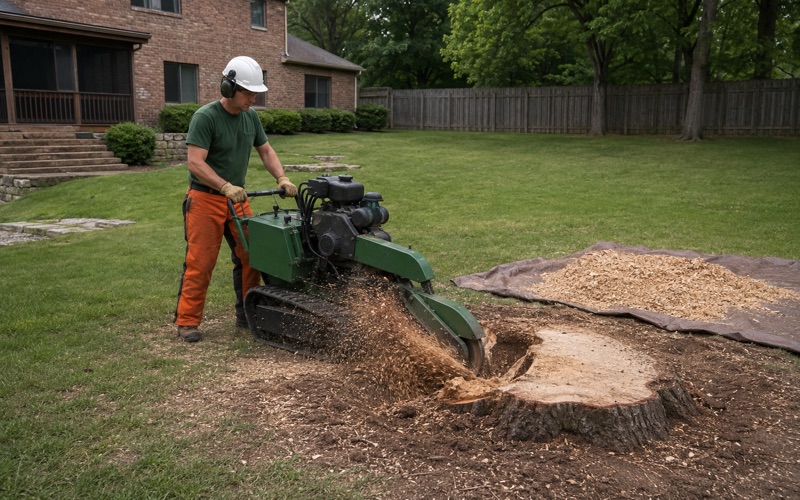
Chert will not stop a tracked stump grinder the way solid rock does, but it dulls teeth fast enough that it belongs in the quote rather than in a surprise partway through the afternoon. We say up front how deep the grind goes and who ends up with the grindings.
Looking for tree removal closer to Murfreesboro? See Murfreesboro Tree Removal.
What the town’s written standards ask of a tree
White Bluff’s tree rules do not live in one place, which is why they surprise people. The zoning ordinance dated June 5, 1990 carries the sight-distance rule; the landscaping and screening standards were deleted and replaced in their entirety by Ordinance No. 222 of December 3, 2002; and the Design Review Manual adopted in 2008 holds the tree preservation language. Reading those first costs less than being told about them afterward.
The sight triangle at a corner
On a corner lot in any district, the ordinance draws a triangle from the intersecting street or railroad center lines and a line joining points 75 feet from the intersection. Inside that triangle nothing may obstruct vision between three and one-half feet and ten feet above the average grade of each street. That provision forces a crown raise or a shrub removal at an intersection here far more often than the condition of the plant does.
Landscaping that has to stay alive
Development other than one- and two-family dwellings has to landscape at least ten percent of the site with trees, shrubs, hedges and flowers, and only the area under the tree canopy projected five years after planting counts toward that minimum. A 20-foot strip is preserved along the roadway, and evergreen screens between commercial or industrial uses and adjoining agricultural or residential zones use trees no more than forty feet apart. All of that screening and buffering vegetation has to be maintained permanently, and the planning commission is directed to consider the vegetation already on the site and on nearby properties, with anything retained noted on the plan.
Four inches of caliper, and the plain ban on topping
Under the Design Review Manual, trees are to be protected and preserved whenever possible, and every tree of at least four inches in caliper removed during or before site development has to be replaced where there is land for it, at a minimum of 1.5 inches caliper for canopy trees and one inch for understory trees. Where a tree at or above that caliper truly has to come out, the replacement matches the removed tree’s caliper by an equivalent multiple, capped at half the property’s supplemental caliper requirement. That standard is easy to plan for and expensive to discover late.
The same manual is blunt about pruning. Plantings are to be kept watered, fed, cultivated and pruned to look healthy in every season, and excessive pruning of site and street trees is strictly prohibited: in the manual’s own words, no topping. We do not top trees anywhere, so complying costs us nothing. Our pruning is worked to the objectives and cut types the ANSI A300 standard defines, crown cleaning, crown raising, crown thinning, crown reduction and deadwooding among them, and our climbing and rigging follow the ANSI Z133 safety requirements.
The manual even asks for windfirmness by name, directing that bands of trees such as fencerows, which would not be wind-firm left as individuals, be kept as an effective screen and wind buffer. On soil that limits rooting depth the way this soil does, that reads as engineering rather than paperwork.
Line clearance, storm debris, and where the wood goes
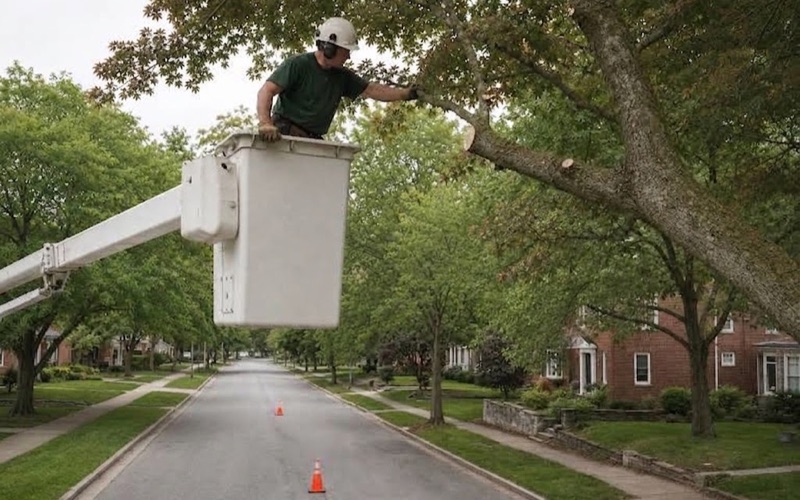
Dickson Electric System is a public utility serving 36,000 customers across Dickson, Hickman, Cheatham, Houston and Montgomery counties, and it reports that vegetation and tree-related outages cause almost 80 percent of its power outages. Its operating policies require it to maintain proper clearance within a 15-foot radius of distribution lines. Work inside that radius is the utility’s to coordinate, and we do not put a crew near an energized conductor.
What the utility leaves, and what it does not
On routine trimming the utility leaves small debris behind for natural degradation, and a customer who wants the wood kept has to ask for that in advance. Storm-caused debris is the property owner’s to remove. A property owner may also hire a private contractor at their own expense to perform trimming that meets the utility’s specifications, which is often the cleaner answer when a whole yard tree needs to come down rather than only the limb reaching toward the line.
Hauling debris out of town
Disposal is worth settling before a truck arrives. The county convenience center at 500 Industrial Drive accepts residential trash only and takes no business waste, so a contracted crew’s load is not going there. We haul our own debris out under our own account, so nothing about disposal falls back on the homeowner mid-job.
Older lots, wooded acreage, and how a job gets scoped
Of the town’s 1,896 housing units, 20.4 percent were built before 1960, and 1,471 of them are single-family detached houses on their own lots. The canopy on those older properties grew up with the houses, which is why so many removals here are mature trees standing close to a roof.
Houses that predate 1960 and the canopy over them
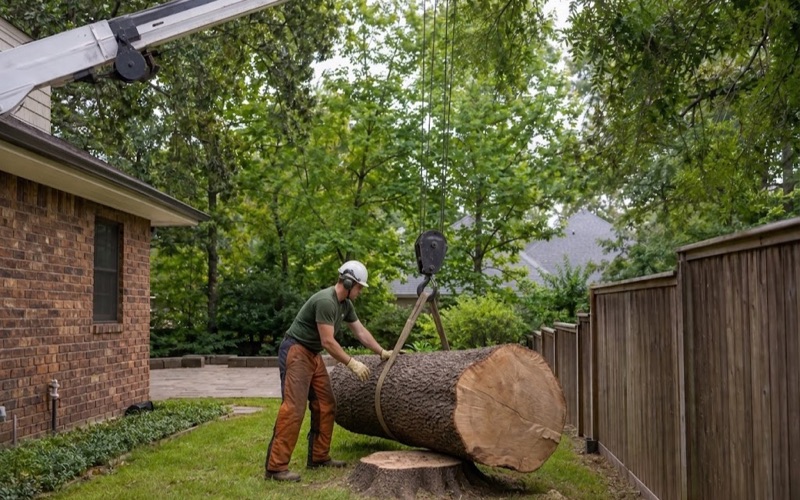
A mature tulip poplar, white oak or post oak over a house from that era is usually a rigging job rather than a felling job. We run compact tracked equipment that fits through a thirty-five-inch gate, so a back-yard tree does not have to become a crane job by default, and we keep crane and rigging capacity for the ones where the canopy really is over the roof. A rigging and lowering device, a spider lift where the ground will carry one, and the chipper set close to the drop zone are what keep the load off a lawn that has to look normal again afterward.
Wooded tracts and clearing by the acre
Dickson County counted 1,060 farms on 124,779 acres of land in 2022, at an average of 118 acres, and the land in farms held 41,814 acres of woodland against 42,996 acres of cropland. Net cash farm income for the county was negative, at minus $903,000 and minus $852 per farm, and 41 percent of farms sold under $2,500 of product. Much of that acreage is land held with trees standing on it rather than a working commercial operation, and work on it is scoped and priced by the acre.
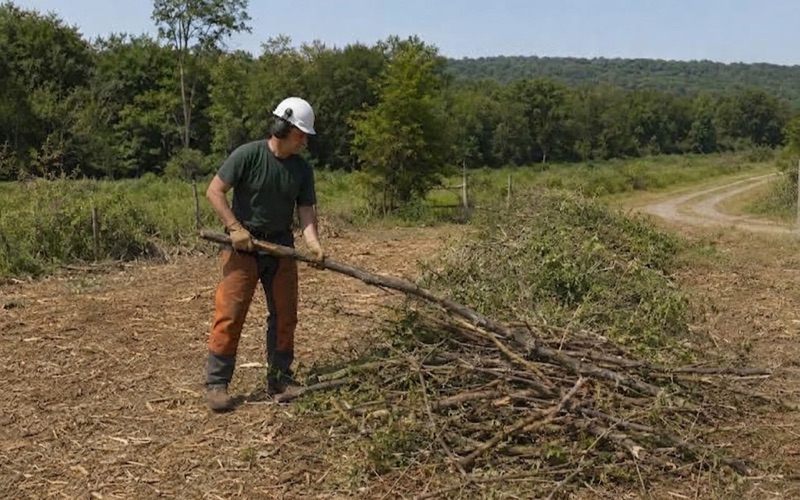
On those tracts the question is usually clearing rather than removal: a fence line to reopen, a drive to widen, a house site to open up. A forestry mulcher handles brush and small stems by the acre, while individual mature trees still come down one at a time. Where we are working next to something that has to stay, we set a tree protection zone and keep the machines out of it, because compaction over the root zone on a pan soil is a slow way to kill the tree you meant to save.
Every job here starts with a free estimate and a walk of the whole property, wooded acreage included. What comes back is a written scope: which stems come down, which equipment reaches them, and what the standards above require to be replaced or left standing.
- 20+ Years in Middle Tennessee
- Free Estimates
- Written Scope Before We Start